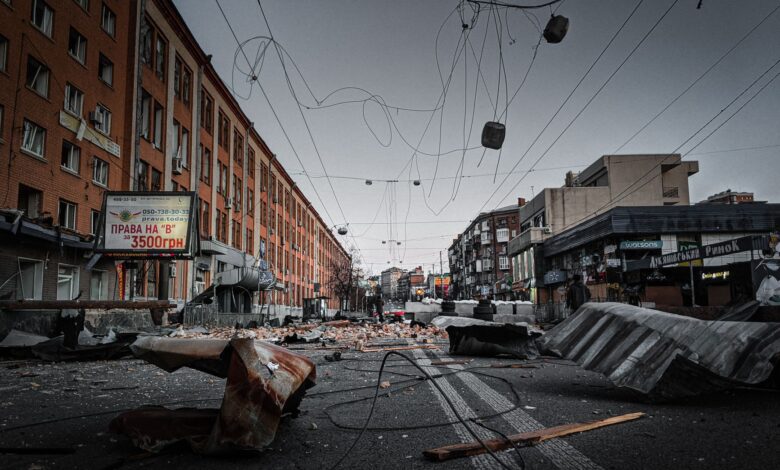
The assault on the academy occurred during working hours, with footage showing a fast-moving drone impacting the structure at a steep angle and exploding. Flames engulfed parts of the historic building, forcing occupants to lean from windows for safety. Volodymyr Horbulin, a former secretary of Ukraine’s National Security and Defence Council, stated that he was at work during the incident. He reported that his assistant, who was near the building, was killed, and that he sustained minor injuries. Emergency officials confirmed two fatalities at the site, with the body of the second victim recovered from the rubble later in the evening. A separate strike on the Shevchenkivskyi district of Kyiv killed a woman, according to the city military administration.
The attacks extended beyond the capital. In Dnipro, a drone struck an office center during working hours, killing three people and wounding at least 12. In Kharkiv, a strike on a nine-story apartment building injured 43 people, including 11 children. In the Chernihiv region, a drone attack on a residential area on Sunday evening hurt four people, including two teenage girls. Ukrainian President Volodymyr Zelensky later released updated figures, stating that nine people had been killed and more than 80 injured in Russian drone strikes throughout the country on Monday.
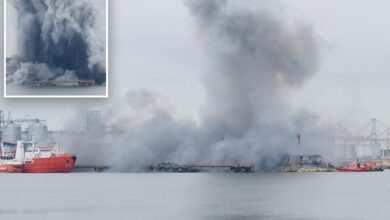
Russian Defense Ministry statements claimed that its forces targeted two data centers in Kyiv, gas stations, a pharmaceutical company, and a distribution hub for the Nova Poshta postal service in Odesa. The ministry also claimed strikes on a cargo ship in the Black Sea and another in the port of Chornomorsk, aiming to curb Ukraine’s grain exports. Moscow’s forces have increasingly utilized faster, high-flying jet-powered drones alongside cruise and ballistic missiles, a shift that has intensified the aerial war as front-line progress has slowed roughly four and a half years into the conflict.
Kremlin spokesman Dmitry Peskov indicated on Monday that the likelihood of rapid progress toward a peace settlement was bleak. “Ukraine will have to pay a price for the actions that have taken place in recent months,” Peskov told reporters, referring to recent Ukrainian attacks, including those during Russian parliamentary elections. These strikes followed a week of diplomatic efforts at the United Nations to advance negotiations. Russian Foreign Minister Sergey Lavrov recently argued that European nations were obstructing peace talks, a narrative Moscow has used to portray divisions within the NATO alliance.
Amid the continued bombardment, Zelensky claimed that North Korea was preparing to deploy an additional 10,000 troops to Russia. He stated that Moscow had already deployed 8,000 North Korean troops and was enlisting foreigners through “various means.” Zelensky called on foreign governments to counter this recruitment drive. Meanwhile, NATO’s Supreme Allied Commander Europe, Alexus Grynkewich, told members of the European Parliament that the goal of Russian hybrid activity was to break the will of Ukraine’s allies. He emphasized that reinforcing the commitment to support Ukraine would signal that Russia’s strategy of exhaustion was not working.
On the Ukrainian side, long-range drone operations continued to target Russian oil refineries and industrial sites. A Ukrainian drone attack in Russia’s southern Krasnodar region killed three people and wounded two, according to local officials. The intensifying exchange of strikes highlights a strategic shift in the conflict, where both sides are increasingly targeting economic and logistical infrastructure to degrade the other’s capacity to sustain the war effort.
The strikes on Kyiv’s scientific institutions and energy infrastructure represent a significant operational escalation, directly impacting the civilian population and Ukraine’s administrative and research capabilities. As diplomatic avenues remain constrained, the military dimension of the conflict continues to expand in both scale and the variety of weapons systems employed.