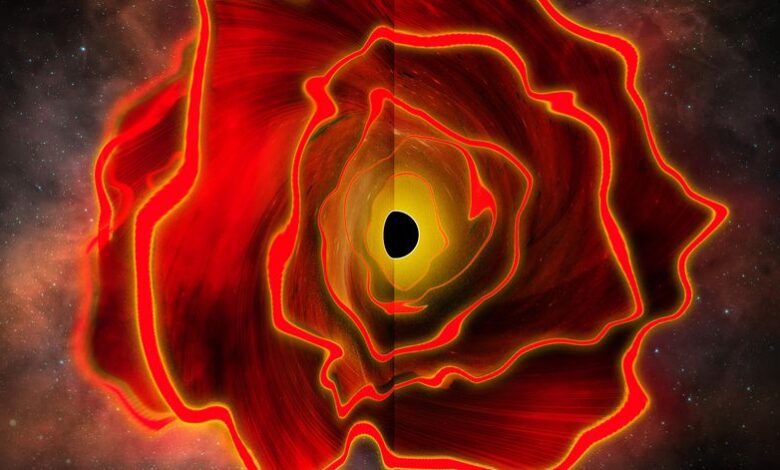
The object presents a paradox to observers. Visually, it resembles a gigantic star, with a physical extent comparable to that of the entire solar system. However, its energy output is incompatible with stellar physics. MoM-BH*-1 emits roughly 100 billion times more energy than any star could produce through nuclear fusion. This luminosity is characteristic of accreting black holes, not stars. The central black hole is estimated to be approximately 100,000 times the mass of the Sun, yet it is obscured by a massive envelope of dense gas that modifies its radiation.
The identification of this object emerged from the Mirage or Miracle (MoM) survey, a project using the James Webb Space Telescope (JWST) to locate the most distant galaxies in the universe. During this survey, researchers encountered numerous bright, compact red spots that did not fit standard classifications. Initially, these “little red dots” were attributed to dust obscuring light, as dust typically absorbs blue wavelengths and shifts the apparent color of objects toward red. However, spectral analysis of MoM-BH*-1 revealed a lack of the metal and elemental signatures typical of dust-obscured galaxies. Instead, the light showed almost no features other than hydrogen and helium.
The defining characteristic of MoM-BH*-1 is an abrupt cutoff in its light spectrum at a specific wavelength, known as a Balmer break. In standard stellar astronomy, this break indicates the presence of dense, photon-absorbing gas in stellar atmospheres, as seen in stars like Vega. However, the break observed in MoM-BH*-1 is significantly deeper and more dramatic than that found in any known star. Rohan Naidu, the study’s lead author, noted that this singularity ruled out ordinary stars as the source. Computer simulations conducted by the team demonstrated that an extremely dense screen of hydrogen gas, rather than dust, could produce such a spectral signature.
The resulting model depicts a black hole at the center, devouring matter and releasing immense energy. As this energy passes through the surrounding dense gas envelope, it acquires the spectral properties associated with starlight. “It shines with the energy typically associated with black holes, but at the same time bears signatures classically associated with stars,” said Naidu. This hybrid nature suggests that MoM-BH*-1 is a black hole so thoroughly swaddled in gas that it radiates in a manner reminiscent of stellar phenomena.
The discovery has significant implications for understanding the early universe. The JWST has detected many similar “little red dots” in deep-space images, and this finding suggests that black hole stars may be the underlying cause of these objects. In most cases, these black hole stars are likely embedded within host galaxies, with the black hole outshining the surrounding stars. MoM-BH*-1 is particularly unique because the black hole star’s light effectively outshines its entire host galaxy, allowing researchers to observe “pure” black hole star light without galactic contamination.
This classification may also shed light on the origin of supermassive black holes, which are found at the centers of most large galaxies, including the Milky Way. The existence of such massive black holes in the early universe has long challenged cosmological models, as they appear to have grown too quickly from standard seed masses. Naidu proposes that black hole stars represent a nascent, swaddled phase in the evolution of these supermassive entities. “Black hole stars may be the ‘something spectacular’ we have anticipated in the very early universe,” he stated. “They may be the nascent, swaddled phase that marks the beginning of almost every supermassive black hole’s journey.”
While the findings provide a compelling explanation for the observed data, the team is continuing to refine their models. Naidu and his colleagues have already secured additional observation time with the JWST, scheduled to begin in December, to determine the precise mass of these objects and analyze the detailed physics of their “stellar” atmospheres. Further observations are needed to confirm whether this class of object is widespread in the early universe and to fully map its role in galactic evolution.