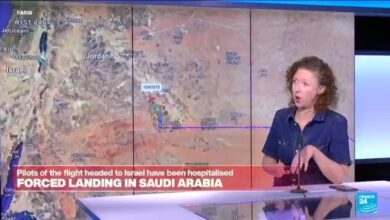

Flydubai Flight 1073, a Boeing 737 Max 8, departed Dubai International Airport shortly after 7:00 a.m. local time with a scheduled arrival at Ben Gurion Airport in Israel approximately three hours later. Roughly two hours into the flight, the aircraft deviated from its normal trajectory, dropping from a cruising altitude of 34,000 feet to approximately 17,000 feet above sea level in just over two minutes. Flight tracking data indicates that ten minutes after this rapid descent, the aircraft’s transponder began squawking code 7700, the international standard for a general emergency. The code was subsequently changed to 7500, which denotes unlawful interference or a hijacking attempt, before reverting to 7700 as the plane altered its course toward Tabuk, a city in northern Saudi Arabia located approximately 270 miles from Tel Aviv.
The aircraft landed safely at Tabuk Airport at 9:44 a.m. local time. Cluster2, the operator of Tabuk Airport, confirmed in a statement that both the captain and the first officer sustained injuries during the incident. The operators stated that the two pilots were immediately transferred to a hospital to receive necessary medical care, though the specific nature of their injuries was not disclosed in the initial report.
Video footage circulating online shows the cockpit interior following the event. In the graphic imagery, the captain is seen wearing an oxygen mask and lying next to a wall smeared with blood. The visual evidence aligns with reports that the first officer, who was reportedly stabbed by the co-pilot at cruising altitude, is among those injured.
Israeli officials have characterized the event as a suspected terror attack. Itamar Ben-Gvir, Israel’s national security minister, stated that a terrorist had planned to crash the plane, intending to murder the 180 Israeli passengers on board. The Israeli Prime Minister’s office confirmed that Prime Minister Netanyahu held consultations regarding the incident and is monitoring developments. The office asserted that the incident is under control and that measures are being deployed to return the passengers safely to Israel.
Initial investigations indicate that the co-pilot involved in the incident is an Omani national who had been employed by Flydubai for less than a year. Israeli authorities are investigating whether the individual held dual citizenship, a factor of particular interest given the strict travel restrictions and lack of direct diplomatic relations between Israel and Oman. While the exact sequence of events inside the cockpit remains under investigation, passenger accounts suggest that the situation was contained by the cabin crew and passengers. Yasmin Abukasis, whose daughter was a passenger on the flight, described the experience as chaotic, noting that passengers were involved in subduing an individual on the jet.
The diversion to Tabuk highlights the operational protocols in place for aviation security in the region. The use of the 7500 squawk code is a critical indicator for air traffic control and military authorities, signaling a threat to the safety of the aircraft and its occupants. The rapid descent of 17,000 feet in such a short timeframe would have subjected the aircraft to significant aerodynamic stress and the passengers and crew to high g-forces, making the safe landing in Tabuk a significant operational outcome.
Flydubai operates multiple daily flights between Dubai and Tel Aviv, a route that serves as a vital link for commercial and diplomatic travel between the Gulf and Israel. The incident has raised questions regarding security screening and cockpit integrity protocols for international flights, particularly those involving crew members from third countries. As the investigation progresses, attention will turn to the forensic analysis of the cockpit records and the medical status of the two pilots, who remain the central figures in this security incident.