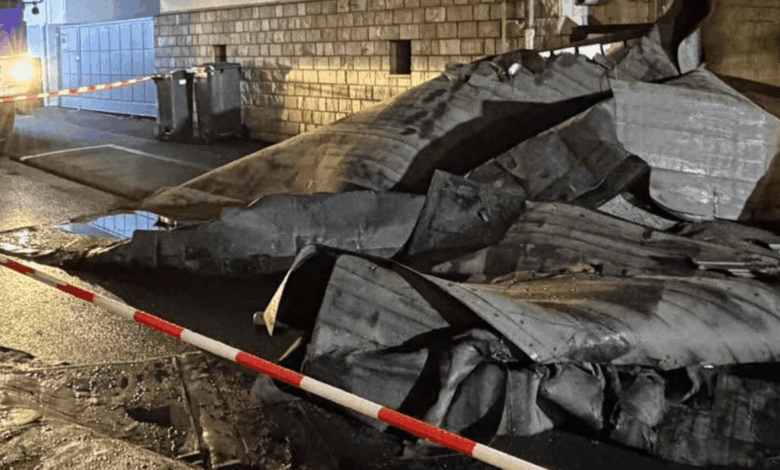
The most significant tornado damage was recorded in Höhr-Grenzhausen, Rhineland-Palatinate, where a vortex moved through the town at approximately 19:20 local time on August 19. A weather station in the nearby Grenzau district recorded peak gusts of 115 km/h (71 mph), though stronger winds were believed to have occurred in areas not monitored by instruments. The event caused extensive structural damage, including the complete removal of numerous roofs and the collapse of gable walls on two buildings. Falling facade sections, airborne debris, and uprooted trees damaged additional properties. While no injuries were reported within Höhr-Grenzhausen itself, one firefighter was hospitalized after sustaining an electric shock during the broader response in Westerwaldkreis. Approximately 550 emergency personnel handled around 160 reported incidents across the district, which includes the towns of Montabaur, Ransbach-Baumbach, Wallmerod, and Wirges.
Power restoration efforts in the affected area progressed steadily. By August 21, all approximately 250 affected medium-voltage transformer substations had returned to service. However, around 100 lower-voltage faults remained, leaving 14 municipalities at least partially without electricity. These remaining failures were primarily caused by damaged building connections and roof-mounted electrical equipment. Network operators indicated that repairs would continue through the weekend, with service restoration for some severely damaged properties potentially taking several additional days.
In Brandenburg, a tornado crossed Fürstenwalde/Spree at approximately 17:15 local time on August 19. The event resulted in three minor injuries: two individuals were struck by a falling tree while in a moving vehicle, and another was injured by broken glass inside a residence. The tornado removed the roof from a daycare center and uprooted numerous trees, with roof debris found up to 600 meters from its source. Preliminary assessments supported a classification of at least IF1 intensity on the International Fujita Scale, corresponding to winds of approximately 150 km/h (93 mph), although the final classification remained under analysis as of August 22.
A second tornado affected the greater Wetzlar area in Hesse, damaging approximately 60 houses in the Münchholzhausen district. Damage ranged from missing roof tiles to the complete removal of roofs, with some sections carried up to 100 meters away. An additional 12 houses were damaged in Solms, two of which were rendered uninhabitable. Temporary accommodation was arranged for two families, and preliminary damage estimates for the Wetzlar area reached the upper six-figure euro range. No injuries were reported in either Wetzlar or Solms.
Separate from the tornado events, a severe storm struck the Saxon Switzerland region in the eastern state of Saxony. A 38-year-old man died near the Felsenbühne open-air theatre in Rathen after being struck by a falling tree in the Amselgrund, a scenic valley popular with hikers. Three others were seriously injured, and ten additional people suffered minor injuries. Authorities evacuated 40 people from the area. The Amselgrund and Lake Amsel were closed to the public, and search operations continued into Saturday to ensure no further victims were unaccounted for.
The German Weather Service confirmed the three tornadoes by August 21, marking a significant episode of severe convective activity for the region. While the specific intensity of the Wetzlar and Höhr-Grenzhausen tornadoes remains under scientific investigation, the cumulative impact has highlighted the destructive potential of localized storm systems in late summer. Emergency services continue to manage the aftermath, with a focus on stabilizing infrastructure and supporting displaced residents in the hardest-hit municipalities.