
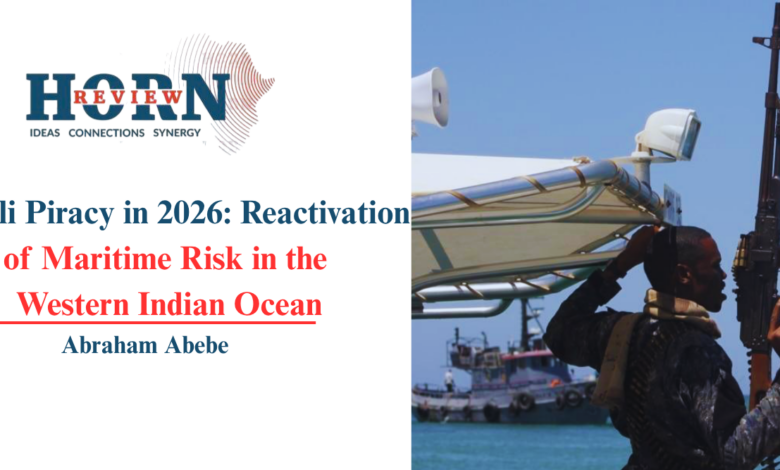
According to the International Maritime Bureau’s Piracy Reporting Centre (IMB PRC), six incidents potentially linked to Somali piracy have been recorded in the first five months of 2026. Five of these occurred in the Somali Basin, while one took place in the Gulf of Aden near the Yemeni coast. The most critical recent events involve the seizure of significant commercial assets. On 21 April, the tanker M/T HONOUR 25 was hijacked off the Somali coast. Two days later, on 25 April, a dhow was captured along the central coastline, likely intended for use as a support or staging platform. On 26 April, the cargo vessel M/V SWARD was boarded while transiting a key commercial corridor linking the Suez-bound route with East African waters.
Maritime security assessments describe this sequence not as isolated acts of crime, but as a calibrated escalation in operational tempo. The interconnected nature of these incidents suggests that pirate groups are transitioning from latent capacity to active deployment, developing a more coordinated operational structure. While the current scale of activity remains limited compared to historical peaks, the pattern indicates the reactivation of dormant maritime networks that were previously suppressed by international naval presence and industry self-protection measures.
Historical context underscores the strategic significance of this resurgence. At the height of Somali piracy in 2011, over 200 attacks were recorded, resulting in 28 successful hijackings and more than 600 seafarers taken hostage. Following coordinated naval operations, including EUNAVFOR Operation Atalanta, and the adoption of Best Management Practice Maritime Security (BMP MS) guidelines by the shipping industry, incidents declined significantly. The industry-designated Indian Ocean High Risk Area was removed in 2023, reflecting a period of stability. However, warnings had been issued as early as the turn of 2023/2024 when reports of increased activity led to nine incidents, including four hijackings, between December 2023 and May 2024. A further five incidents were recorded in 2025, serving as a precursor to the current sharp increase in 2026.
Tactical assessments indicate that Somali pirate groups retain the capability to operate far from their coastal bases. Attacks are commonly executed using small, fast skiffs, sometimes deployed from larger “mother vessels” such as hijacked fishing boats or dhows. Recent operations have been recorded as far as 800 nautical miles from the Somali coast, with the potential to extend further into the Indian Ocean under favorable conditions. Pirate groups have demonstrated the ability to board vessels with a freeboard of 10 metres or more. However, data indicates that boarding vessels maintaining speeds of 18 knots or higher is significantly more challenging, suggesting that speed and maneuverability remain critical defensive factors for commercial shipping.

The strategic implications extend beyond immediate local security. The Western Indian Ocean and Gulf of Aden serve as critical corridors linking global trade networks to the Red Sea and the Suez Canal. The re-emergence of piracy poses risks to the stability of these vital shipping lanes. While the initial incidents in early 2026 were limited to an attempted attack and the hijacking of a single dhow, the subsequent escalation in April highlights a shift in behavior. The capture of the M/V SWARD and the M/T HONOUR 25 demonstrates that pirates are targeting high-value commercial assets in transit, rather than limiting themselves to coastal or stalled vessels.
In response to the heightened threat, maritime authorities advise vessels operating in the region to maintain a vigilant watch and fully implement BMP MS guidance. Mariners are urged to report any suspicious activity, including sightings of unidentified skiffs, to the United Kingdom Maritime Trade Operations (UKMTO) and the Maritime Security Center Indian Ocean (MSCIO). The situation remains fluid, with the primary military and commercial objective now being the recovery of the three hijacked vessels and the disruption of the expanding operational capacity of pirate groups. The next confirmed development will likely hinge on the effectiveness of ongoing naval patrols and the ability of the industry to adapt its protective measures to this renewed threat landscape.