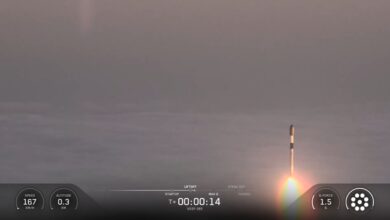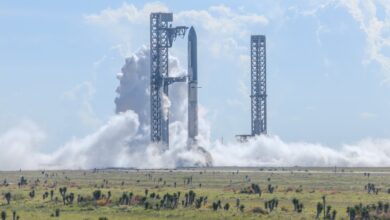
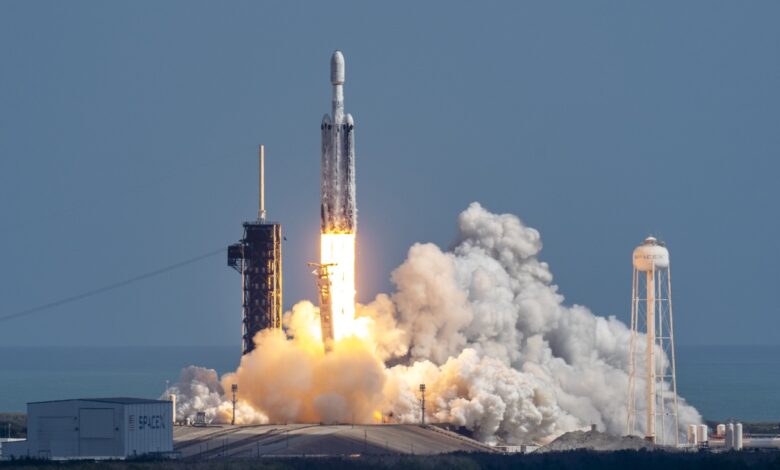
On Monday, three days before the targeted launch window, SpaceX revealed the Falcon Heavy rocket inside the hangar at Launch Complex 39A. The company released footage and still images showing the rocket’s engine section while it sat horizontally in the assembly area ahead of its rollout to the launch pad. The 21-second video provides a detailed view of the 27 Merlin engine nozzles, arranged in a grid beneath the rocket’s three first-stage cores. Each core carries nine engines, and the footage pans across the engine bells, offering one of the last public looks at the vehicle before it moves to the pad.
The Falcon Heavy is configured for this mission with the center core expended, while the two side boosters are expected to be recovered at a landing zone. This launch would mark the second Falcon Heavy flight in about a month. The previous flight occurred in late August and carried NASA’s Roman Space Telescope to orbit from the Space Coast. That mission was initially previewed for an August 30 liftoff, but the telescope departed the following day.
The NROL-97 payload remains undisclosed, as is standard for NRO missions, which the agency books under the NROL designation without releasing technical details about the spacecraft. The late-night launch window places the event in the early morning hours of Friday, October 2, in other time zones, but it remains strictly within the scheduled Thursday timeframe in local Eastern Time.
Operational Context and Recent Activity
SpaceX’s launch manifest lists the flight as NROL-97, confirming the involvement of the National Reconnaissance Office. The agency is responsible for operating reconnaissance satellites and other space-based missions for the United States government. The consistent use of the Falcon Heavy for these heavy-lift classified missions underscores the rocket’s role in national security deployments.
The visual documentation released by SpaceX highlights the engineering scale of the Falcon Heavy. The grid arrangement of the 27 Merlin engines is a distinctive feature of the vehicle, allowing for redundant propulsion systems and high payload capacity. The images show the intricate nozzle structures from below, emphasizing the complexity of the first-stage assembly before flight.
With the rocket already positioned in the hangar, the next phase of operations involves rolling out the vehicle to the launch pad. The proximity of the reveal to the October 1 target date suggests that the mission is proceeding on schedule. The successful launch of the Roman Space Telescope just weeks prior demonstrates the operational readiness of the Space Coast infrastructure and the Falcon Heavy launch team.
As with previous NROL missions, public information regarding the specific capabilities or purpose of the NROL-97 payload is limited. The focus remains on the technical execution of the launch, including the recovery of the side boosters and the safe disposal of the center core. The mission represents a continuation of the established partnership between SpaceX and the NRO for heavy-lift space access.
The launch window of 11:53 p.m. ET on October 1 will be the next major milestone for the Falcon Heavy program in this sector. Observers will look to the recovery operations at the landing zone for the side boosters, a critical component of the cost-reduction strategy for heavy-lift launches. The center core, being expended, will re-enter the atmosphere after the upper stage performs its orbit insertion burn.
No further details on the payload have been released. The NRO does not disclose specifications for its classified missions, leaving the technical particulars of NROL-97 to speculation until any official announcements are made post-launch. The primary public interest lies in the performance of the 27-engine stack and the precision of the booster recovery, which have become standard expectations for Falcon Heavy missions.
The rollout from the hangar to Launch Complex 39A is the immediate precursor to the launch. Once on the pad, the rocket will undergo final checks and fueling, with liftoff targeted for the specified late-night slot. The alignment of this mission with the recently completed Roman Space Telescope launch highlights the high tempo of operations at the Kennedy Space Center.
SpaceX has not indicated any changes to the schedule since the initial manifest release. The classification of the mission ensures that media coverage will focus on the launch mechanics and the vehicle’s performance rather than the payload’s mission parameters. The 27 Merlin engines, prominently featured in the recent hangar footage, will provide the thrust necessary to place the NROL-97 spacecraft into its intended orbit.
The upcoming launch serves as a test of the Falcon Heavy’s reliability in a high-cadence operational environment. The successful recovery of the side boosters will further validate the reusability concepts that underpin the rocket’s design. As with all classified NRO missions, the specific outcomes and capabilities of the NROL-97 spacecraft will remain undisclosed, maintaining the secrecy inherent to reconnaissance operations.
The October 1 launch will be the next significant event for the Falcon Heavy program following the August deployment of the Roman Space Telescope. The focus for engineers and observers will be on the engine performance and the precision of the landing operations. The mission continues the pattern of using the Falcon Heavy for high-priority, heavy-payload launches from the Florida coast.