
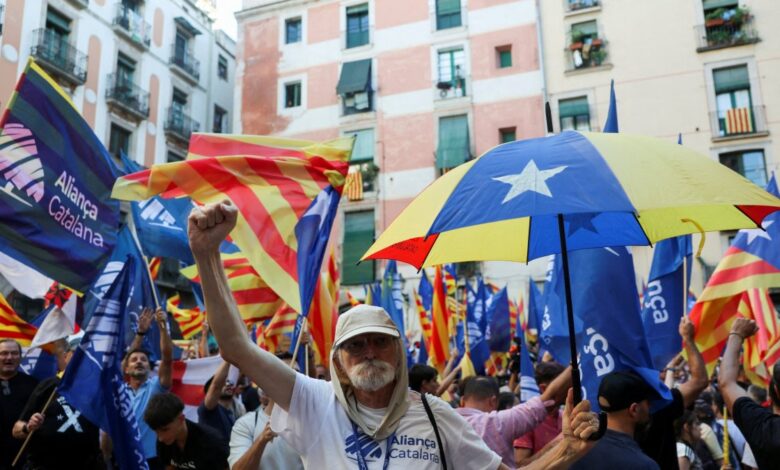
Aliança Catalana, a far-right separatist party, has surged in recent polls to rank second behind Spain’s ruling Socialists, positioning it as a major player in the upcoming 2028 regional election. The party’s ascent is driven by a political message that focuses increasingly on curbing immigration and tackling crime, rather than solely on secession. This thematic shift mirrors a broader trend where voters are prioritizing public safety and migration controls over the constitutional question of independence. According to a Catalan government survey published in July, much of Aliança’s support comes from working- and middle-class voters in rural areas outside the capital, as well as former backers of the separatist center-right party Junts and the far-right, anti-independence Vox party.
The party’s growth is personified by its leader, Silvia Orriols, a 41-year-old former librarian from a middle-class farming family. Her outspoken leadership has helped consolidate support across Catalonia’s traditional political divides. Although Aliança states it would pursue unilateral independence from Spain if it won power in the wealthy northeastern region, its practical political strategy has been to address the immediate concerns of its base regarding social order and demographic change.
Fragmentation of the Separatist Front
The rise of Aliança Catalana poses a structural challenge to the independence movement’s ability to form a governing coalition. Traditional pro-independence parties have explicitly ruled out governing agreements with Aliança, citing ideological differences. This refusal creates a potential deadlock in efforts to unseat the region’s ruling Socialist Party. The September 11 clashes underscored these tensions, as the historical gathering for pro-independence crowds was overshadowed by conflict between different factions of the movement.
In response to the shifting political wind, other separatist parties have begun to adopt more conservative positions to remain competitive. Some have lobbied Madrid to allow the region to restrict migration, a policy stance that was previously less prominent in the separatist discourse. This adaptation illustrates how the issue of immigration has become a central axis of Catalan politics, eclipsing the binary debate on independence for many voters.
The political significance of Aliança’s rise lies in its ability to attract voters who feel disenfranchised by the traditional left-right divide. By combining separatist identity with a hardline stance on crime and immigration, the party has tapped into anxieties that have gained traction in broader European politics. However, the movement remains uncertain in its long-term viability. While Aliança is currently strong in the polls, the ability of the traditional separatist parties to either co-opt this new agenda or maintain their distinct identity will determine the political configuration of Catalonia in 2028.
For now, the region faces a complex political environment where the goal of independence is no longer the sole defining factor for voter alignment. The next political development will likely hinge on how the major parties navigate the growing influence of far-right separatism and whether the traditional coalitions can adapt to a electorate that is increasingly focused on domestic security and immigration policy. The upcoming election will test whether Aliança Catalana can translate its polling strength into legislative power or if the fragmentation of the separatist vote will ultimately benefit the ruling Socialists.