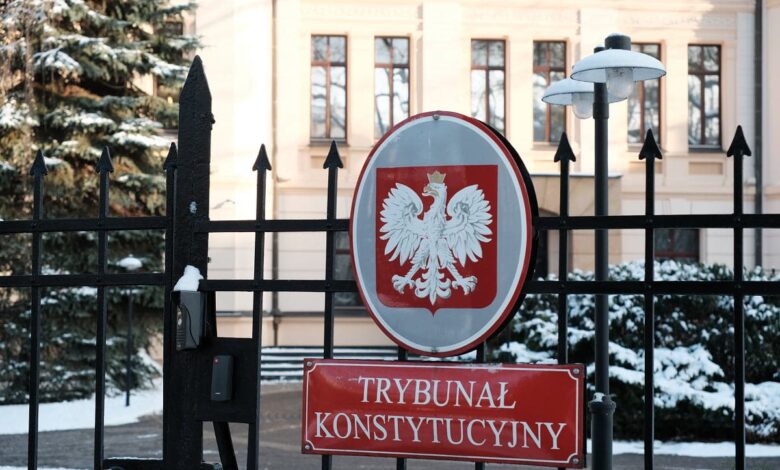
The central legal development is a directive issued by Anna Korwin-Piotrowska, the acting head of the Tribunal. In a written order, she suspended the performance of official duties for Tribunal staff, including the requirement to report to the headquarters. The exception was made only for employees explicitly notified of their need to be present. Korwin-Piotrowska, who holds the position of acting head under the current government’s recognition, justified the measure by citing an increased risk of public order violations in the vicinity of the Tribunal building. Beyond suspending physical attendance, she restricted the activities of the Tribunal’s Chancellery and Legal Service Bureau to tasks defined solely by her, and she halted the operation of the reception desk, ordering that all correspondence be sent via postal operators.
This directive immediately collided with the authority of Bogdan Swojakowski, the President of the Constitutional Tribunal, whom the government considers removed from office. Swojakowski, who is still recognized as the head of the institution by the Tribunal’s own social media channels, declared that Korwin-Piotrowska’s letter regarding the organization of the court’s work carries no legal force. In direct counter-measure, Swojakowski announced four days of leave for court staff from November 3 to 6. The divergence is stark: while one leadership faction orders a suspension of duties due to safety concerns, the other asserts the legality of its own continued operation and declares the rival’s administrative actions void.
The principal legal question at the center of this crisis is one of institutional legitimacy and the scope of executive power over the judiciary. The government, under Prime Minister Donald Tusk, moved to remove Swojakowski and his deputy, Bartlomiej Sochanski, from their posts. On Friday, a notice appeared on the official website of the Constitutional Tribunal announcing their removal. However, the Tribunal’s page on the social media platform X posted the opposite message, stating that the court’s website had been “seized” and that Swojakowski continued to perform his duties. This dual narrative creates a bifurcated reality for the institution: one version sanctioned by the executive branch, and another asserted by the judicial body itself.
The wider public consequence of this legal impasse is the physical and operational shutdown of the Tribunal. The suspension of the reception desk and the redirection of correspondence to postal services signal a retreat from public engagement and immediate legal processing. For citizens and legal entities seeking constitutional review, the path to the court is now obstructed not just by physical security measures, but by contradictory administrative orders from rival leaderships. The situation reflects a broader breakdown in the separation of powers, where the executive branch’s assertion of authority over the judiciary is being met with institutional resistance and claims of procedural illegitimacy.
Political reactions have further escalated the tension surrounding the legal dispute. Foreign Minister Radoslaw Sikorski defended the police actions near the Tribunal, stating that their objective was to allow “legally elected judges” to resume the institution’s work. This statement aligns with the government’s position that the new leadership is legitimate and that the opposition’s attempt to enter the building was an obstruction of legal proceedings. Conversely, the presence of opposition leaders at the protest site underscores the view that the government’s actions are an illegitimate takeover of the court. President Karol Nawrocki, in response to the escalating situation, declared a “threat to internal security” and convened emergency consultations with representatives of parliamentary forces, framing the judicial dispute as a matter of state stability rather than a purely legal or procedural issue.
What remains disputed is the ultimate validity of the removal of Swojakowski and the subsequent appointment of Korwin-Piotrowska. Until this question is resolved through a recognized legal or political mechanism, the Tribunal exists in a state of administrative limbo. The court’s ability to function as an arbiter of constitutional law is compromised by the uncertainty over who has the authority to manage its affairs. The conflicting directives—Korwin-Piotrowska’s suspension of duties and Swojakowski’s declaration of their illegality—leave staff and the public without a clear chain of command.
As the week moves forward, the immediate focus returns to the physical and administrative status of the Tribunal’s headquarters. With staff on leave or working remotely, and the reception desk closed, the institution is effectively closed to the public. The next confirmed legal step will likely depend on the outcome of the emergency consultations led by the President and whether either faction can present a unified legal argument for their legitimacy. Until then, the building that houses Poland’s constitutional guardian remains a symbol of a fractured legal order, where the rules governing its own operation are in direct conflict with the authority claiming to enforce them.