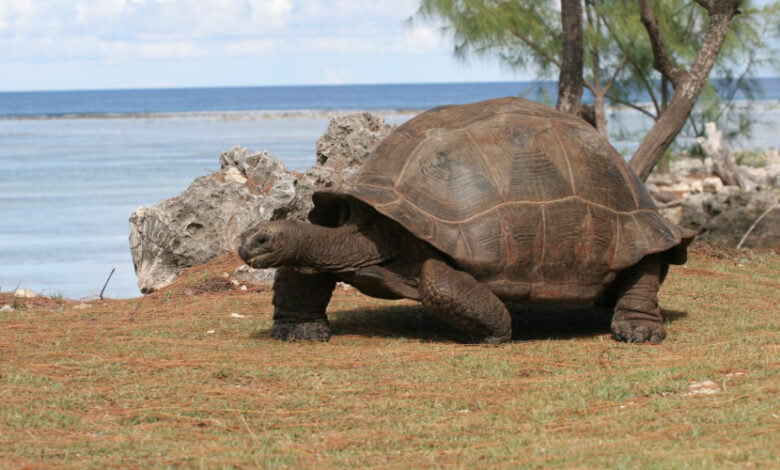
The new estimate, led by the Seychelles Islands Foundation (SIF) and the University of Exeter, supersedes the widely cited figure of 100,000 tortoises from the late 1990s. However, researchers caution that the apparent near-doubling of the population does not solely reflect a recent surge in numbers. Instead, the new survey employed a sophisticated statistical technique known as Bayesian hierarchical distance sampling. This method corrects for animals that are present but hidden within the atoll’s dense vegetation, a limitation that likely caused earlier surveys to underestimate the true population size. By modeling both observed and unobserved tortoises, the team established a more reliable baseline for the species, with a best estimate of nearly 183,000 adult and sub-adult individuals.
Aldabra Atoll is one of only two places in the world where giant tortoises are found in the wild, the other being the Galapagos. The species’ recovery is considered one of the greatest conservation successes in the Indian Ocean. In the 19th century, heavy exploitation reduced the population to fewer than 1,000 individuals. The turning point came in the early 1980s when Aldabra was designated a strict nature reserve in 1981 and subsequently recognized as a UNESCO World Heritage site in 1982. Since then, continuous monitoring and protection have allowed the population to stabilize and grow.
“More than 180,000 giant tortoises roaming freely on our atoll is proof of what long-term commitment to conservation can achieve,” said Dr. Frauke Fleischer-Dogley, CEO of the Seychelles Islands Foundation. “This is wonderful news for Seychelles, for the world, and for everyone who has worked to protect Aldabra.”
Photo by Joolsmagools ®️ on Pexels
The study also provides detailed insights into the tortoises’ habitat preferences. Populations are densest in the grasslands, often referred to as “tortoise turf,” followed by open exposed surfaces and open mixed scrub. In contrast, tortoises are harder to detect in dense scrub, mangrove, and *Pemphis* habitats. The new statistical models help account for this reduced visibility, ensuring that the overall population estimate remains accurate despite the challenges posed by the atoll’s thick vegetation.
Despite the positive trends, the researchers emphasize that vigilance remains essential. The atoll is facing increasing environmental pressures from climate change. Predictions indicate that longer and more frequent droughts will reduce the availability of shade and food for the tortoises. Additionally, rising sea levels pose a direct threat to the low-lying parts of the atoll, which may become increasingly vulnerable to inundation.
Invasive mammals continue to be a critical threat. While feral goats, which had devastated the atoll’s vegetation, were successfully eradicated in 2012, feral cats and black rats remain. These predators prey on tortoise eggs and hatchlings, hindering population growth. The study’s authors suggest that the planned eradication of these remaining invasive species could remove the last major barriers to population expansion, helping the tortoises build resilience against future climate pressures.
Photo by Diego F. Parra on Pexels
Dr. Dave Hudson, a Postdoctoral Research Associate at the University of Exeter who supported the development of the statistical framework, noted that the new figures provide a crucial baseline rather than an endpoint. “It’s important to remember that the numbers provide a baseline – not an endpoint,” Hudson said. The goal is to provide conservation managers with the evidence needed to track future changes and act early as the tortoises face escalating environmental challenges.
The recovery of the Aldabra giant tortoise stands as a testament to the effectiveness of sustained, science-based conservation efforts. Yet, as the climate shifts and new threats emerge, the stability of this iconic population remains a work in progress, dependent on continued management and adaptation.
Peter Lewis covers climate and environmental news, including extreme weather, climate policy, emissions, conservation, pollution, and biodiversity. He follows scientific findings, government decisions, and major environmental developments while paying attention to the difference between established evidence and emerging claims. Peter's reporting provides useful context without overstating what current research can support.