
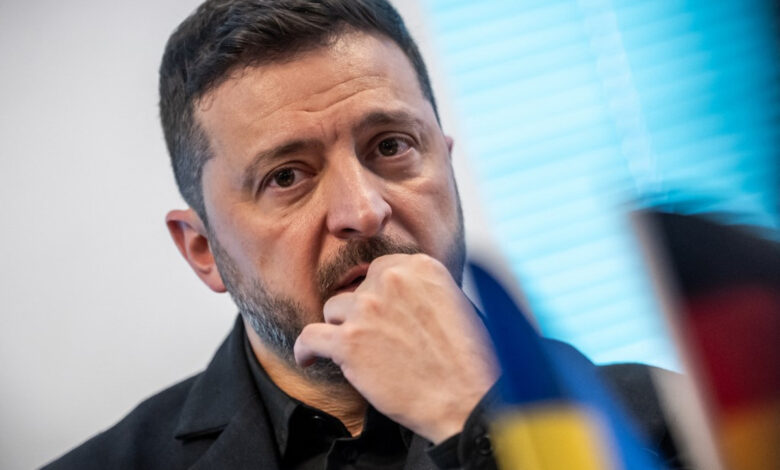
“We are very thankful for this. Now it works,” Zelensky told Welker, confirming that the data pipelines, which had been blocked for a “certain period of time,” were functioning again. The restoration of these channels is a critical development, as intelligence sharing forms the backbone of Ukraine’s ability to track Russian movements and mitigate threats. According to Zelensky, the suspension lasted only a few days, a brief but significant pause that highlighted the fragility of the security partnership in the face of strategic disagreements.
The temporary halt in intelligence flows emerged from sharp divergences between Washington and Kyiv over battlefield targeting rules. The immediate catalyst for the friction was a series of long-range Ukrainian strikes against Russian oil refineries and petrochemical facilities. On October 9, during talks in Miami, representatives of the Donald Trump administration warned Ukrainian officials that intelligence sharing could be suspended if these strikes continued. This warning was later formalized; on October 15, The Washington Post reported that US intelligence officials informed Ukraine’s embassy in Washington that data exchanges would be halted immediately if attacks on energy infrastructure persisted. The dispute was linked to an “energy ceasefire” unilaterally declared by President Donald Trump, a mechanism intended to stabilize fuel markets but viewed by Kyiv with skepticism.
The tension was further exacerbated by a specific incident on October 12, when a Russian ballistic missile strike hit civilian infrastructure in Kyiv. Five missiles struck the capital, and Zelensky stated at the time that Ukraine had not received timely warning from foreign partners about the launch. This gap in early-warning capabilities brought the issue of intelligence support to the forefront of the diplomatic agenda. It is worth noting, however, that on October 13, President Trump publicly stated that Washington had not stopped sharing intelligence with Ukraine and that assistance continued, creating a brief period of conflicting signals between the executive branch’s public statements and the operational realities reported by Kyiv.
Beyond the missile warnings, the diplomatic friction extended to other technological dependencies. Zelensky noted that Ukrainian officials viewed SpaceX’s decision to restrict the operation of Elon Musk’s Starlink system as a response to a message from the American government. Ukraine continues to face restrictions on using Starshield, the military version of Starlink. These terminals lose connectivity when moving above 160 km/h, a limitation that complicates Ukrainian drone operations, particularly for interceptors targeting Russian jet-powered drones. The interplay between commercial satellite restrictions and state-level intelligence flows underscores the complex technical and political dimensions of the current security arrangement.
The geopolitical stakes extend beyond the battlefield to the global energy market. President Trump recently announced an agreement with Russia allowing Moscow to supply 300,000 metric tons of diesel fuel to the global market, with hopes of addressing sharp rises in fuel prices. Zelensky challenged the efficacy and motives behind this deal, arguing that the agreement would not have a “real influence” on oil prices in the United States, as the price surge was driven by the closure of the Strait of Hormuz rather than the war in Ukraine. “I don’t know all the reasons why President Trump makes such deals,” Zelensky said. He further warned that the agreement would “strengthen Putin in his will to occupy us,” suggesting that easing energy pressures on Russia could bolster its capacity for military aggression.

The interview also touched on the personal dynamics between the two leaders. Responding to President Trump’s earlier comment that Zelensky was “more difficult to deal with than Putin,” the Ukrainian president defended his approach. “Maybe it’s not very polite,” Zelensky said, “but it is better to have partners who are very open and clear than to have those who are killers, even with a smile on their face.” Zelensky characterized his dealings with Trump as “very honest,” prioritizing transparency over diplomatic niceties in a high-stakes conflict.
As the intelligence flows return to normal, attention turns to the near future. Zelensky expressed hope that bilateral negotiations with American officials would convene within the coming week. These talks are expected to address the recent early-warning gaps and broader security coordination, particularly as winter approaches. The resolution of this brief suspension marks a tentative step toward stabilizing the US-Ukraine relationship, but the underlying disagreements over targeting rules and energy policy remain unresolved. The coming week will determine whether this restoration of data sharing signals a durable alignment or merely a pause in the ongoing diplomatic friction.