The primary driver of this recent volatility is the release of U.S. economic data, specifically the Bureau of Economic Analysis (BEA) report on Personal Consumption Expenditures (PCE) prices. In September, PCE prices rose 0.5% month over month and 3.6% year over year. Excluding food and energy, core PCE prices increased 0.3% monthly and 3.1% annually. For gold, this data presents a dual-edged sword. While persistent price pressure can encourage demand for purchasing-power protection, it also reinforces the expectation that the Federal Reserve may maintain restrictive policy longer than anticipated. This increases the appeal of competing interest-bearing assets, such as U.S. Treasuries, which pay a yield, unlike gold, which pays no coupon or dividend.
The mechanics of gold pricing are heavily influenced by real yields and the U.S. dollar. Real yields represent the opportunity cost of holding bullion; when they fall, gold becomes more competitive. However, the relationship is not perfectly linear. On October 28, the Treasury’s 10-year real par yield fell to 2.63% from 2.67%, while the 5-year yield declined. In principle, lower returns should reduce the opportunity cost of gold. Yet, gold did not rally in response, suggesting that other factors—such as currency conditions, liquidity preferences, and defensive positioning—overwhelmed the yield-driven support. The dollar’s strength further complicates the picture, as a stronger greenback mechanically raises the cost of gold for non-U.S. buyers, particularly in Asia, where physical demand is price-sensitive.

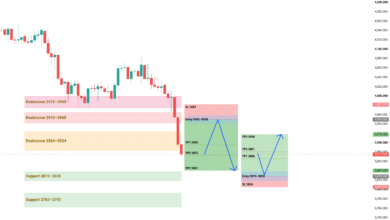
Market sentiment is currently extremely bearish, with technical analysts pointing to a “Fair Value Gap” (FVG) between 3,923 and 3,950 as a key reaction area. Price is currently retesting this zone, and traders are watching for a bearish rejection to confirm further downside movement toward targets of 3,836–3,850, with major support at 3,812.181. Conversely, a sustained move above 4,012–4,032 would weaken the bearish outlook. The current setup closely resembles the 2022 midterm election pattern, where gold established a major bottom just days before voters went to the polls. In 2022, prices peaked in the first quarter, bottomed in July, rallied into August, and formed a final bottom days before the November elections. Analysts suggest the current correction could follow a similar trajectory, with a potential bottom forming in the near term.
The upcoming U.S. elections introduce a significant geopolitical and policy variable. If Republicans lose significantly in the November elections, there is speculation that President Trump could take an aggressive stance toward Iran, a geopolitical risk that could act as a wild card for precious metals. Crude oil is also a factor; a sustained breakout above $105 could trigger a rapid advance toward $120, potentially impacting inflation expectations and gold prices. However, if Democrats sweep both the House and Senate, a broader equity selloff could drag gold below $3,800. Under that scenario, analysts suggest a potential bottom might not form until the December 9 Federal Reserve announcement.
The Federal Reserve’s recent actions add to the uncertainty. At the October 28 meeting, the Fed maintained its target range of 3.75% to 4%, with two dissenters preferring a quarter-point increase. An unchanged target does not guarantee the next move will be a cut; in fact, traders are currently betting on an interest-rate hike in December. This policy backdrop underscores the distinction between an inflation concern and an automatic bullish signal for gold. The balance between the protective demand for gold and the appeal of higher-yielding assets remains the central tension in the market.

Other precious metals are also under pressure, reflecting the broader bearish sentiment. Silver is trading within a falling wedge pattern, retesting its lower trendline, with a potential backtest of the breakout area near $49.50. Platinum has broken below $1,500, raising the possibility of a further decline toward support at the lower trendline. Mining stocks have surrendered most of their August gains, with prices approaching final gap support near $76.00. Despite the current weakness, some analysts expect miners to outperform gold going forward, provided a bottom is established above the July low.
As the market approaches the critical election period, the legibility of gold’s price action is high but the predictability is low. Gold is a near-pure expression of real yields and the dollar, making it the “honest” asset in a Fed day, where equities can be carried by buybacks and credit by issuance calendars. However, the safe-haven bid is often overrated; in a genuine risk-off shock, capital flows to Treasuries and the dollar first, with gold following only after the initial dash for cash. Traders are advised to monitor the reaction at the 3,923–3,950 FVG zone, as a failure to reclaim this area would strengthen the bearish continuation scenario. The next policy decision and data releases will be crucial in determining whether gold establishes an immediate bottom or extends its correction for another month.