
The primary driver behind this retreat is a fundamental repricing of interest rate expectations. At its October meeting, the Federal Reserve held rates steady, but the tone of the decision was hawkish. Two voting members dissented, advocating for a 25-basis-point hike. Chair Warsh explicitly stated that “overall financial conditions have not reached a sufficiently restrictive level,” signaling that further monetary tightening remains on the table. This stance is reinforced by persistent inflationary pressure. U.S. Consumer Price Index (CPI) data for September showed headline inflation rising to 3.7% year-on-year, with core CPI rebounding to 2.6%. Furthermore, the Personal Consumption Expenditures (PCE) index has remained above the Federal Reserve’s 2% target for the 68th consecutive month. In the futures market, the implied probability of a rate hike in December has climbed to approximately 78%, a level that exerts significant downward pressure on gold, a non-interest-bearing asset.
Supply-side pressures are also contributing to the bearish momentum. Geopolitical tensions in the Middle East have pushed oil prices above $110 per barrel. Analysts note a clear transmission chain: rising oil prices feed into persistent inflation, which in turn heightens expectations for higher real interest rates. This dynamic has altered the flow of “safe-haven” capital. With a recent cooling in AI-related trading, demand for safety has shifted away from gold and toward U.S. Treasuries, which offer both yield and a hedge against inflation. This shift is visible in institutional flows: global gold ETFs recorded a single-day net outflow of approximately 10.5 tonnes, the largest redemption since late August.

Technical analysts across multiple timeframes agree that the trend is firmly bearish, though they debate the precise timing of potential rebounds. On the daily chart, the price has broken below the invalidation level of the previous bullish impulse structure. One Elliott Wave analysis suggests the current correction could develop into a Triangle or a WXY corrective structure, with momentum indicating the bearish move could continue for another 2–3 days before a new swing low forms. The $3,880 swing low is identified as a critical support area, aligning with a Fibonacci target. Analysts favor a scenario where price sweeps liquidity below this low to test a Bullish Order Block deeper in the range, which could potentially mark the beginning of a new trend.
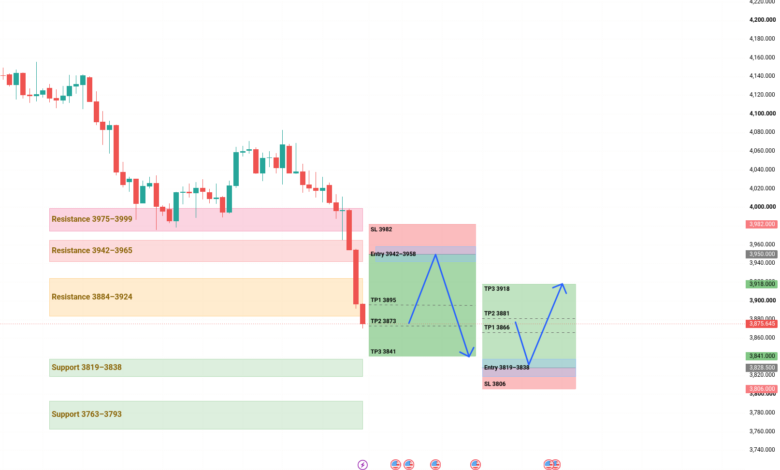
From a trading strategy perspective, the consensus for the week of November 2–6 is bearish, with a focus on selling into pullbacks rather than chasing the decline. Key resistance levels for any short-term rebound are identified in the $3,942–$3,958 range, which corresponds to broken weekly lows from June and July. A further barrier exists at $3,990–$4,020, where the lower boundary of a previous consolidation platform meets the medium-term downward trend line. If price fails to reclaim the $4,065–$4,080 “accelerated decline zone,” the bearish outlook remains intact.

Support levels are currently being tested in the $3,819–$3,838 range, which includes daily lows from early October 2025. Analysts advise against catching a “falling knife” and suggest waiting for Higher Timeframe (H4) confirmation before attempting counter-trend buys. A decisive daily close below $3,806 would open the door for further downward movement toward the $3,763–$3,793 support zone. Conversely, the bearish view is invalidated if the price closes above $3,982, which would turn the recent break of $3,942 into a false break.
As the market enters the first week of November, the focus shifts to whether the $3,876 intraday low holds. The technical indicators on the 2-hour timeframe show the asset in deeply oversold territory, creating the potential for a corrective rebound. However, within a strong bearish trend, such conditions can persist. The next critical test will be whether price can climb back above $3,990 with increased volume. If it fails, the structural weakness remains, and the road to the $3,819 support zone becomes the primary concern for traders managing their gold exposure.