Prosecutors allege that between 2022 and December 2024, Abdul-Hamid, Jacob Kwamina Amuah, and Wendy Newman utilized their official positions at the NPA “without lawful mandate” to collect approximately GHc 280 million (roughly $27 million) from petroleum transporters and oil marketing companies. According to the OSP, Amuah allegedly transferred GHc 24 million ($2.3 million) directly to Abdul-Hamid between January and December 2024 as part of this scheme. The accused are charged with unlawful conduct involving the diversion of public funds and collusion with bulk distribution companies.
This domestic legal action coincides with intensified international enforcement efforts against Ghana-linked fraud networks. The United States Attorney’s Office for the Northern District of Ohio confirmed the arrest and indictment of Ghanaian twins Jamal and Kamal Abubakari, known by the aliases “Arrangement” and “Lancaster,” alongside Amanda Joy Opoku-Boachie. The trio is accused of conspiracy to commit wire fraud and money laundering, allegedly targeting elderly Americans through romance scams on dating sites and social media. US authorities stated that the suspects used fake identities to convince victims to transfer money, a scheme that is part of a wider FBI-led crackdown on illicit financial flows originating in West Africa.
These parallel proceedings have amplified debate within Ghana regarding the adequacy of existing anti-corruption laws. Speaker of Parliament Alban Bagbin has confirmed that lawmakers are drafting a bill to empower state institutions to probe public officials, politically exposed persons, and private individuals whose wealth cannot be justified. Bagbin stated the legislation aims to “stop this impunity of people flaunting ill-got wealth.” The proposed law would introduce lifestyle audits, a mechanism currently absent from Ghana’s legal framework despite recommendations from independent research.
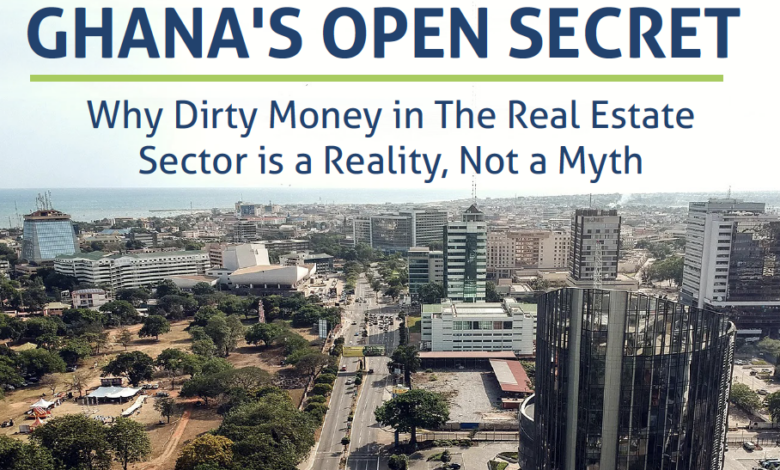
Independent research by Global Financial Integrity identified significant money laundering trends within Ghana’s real estate sector, uncovering 16 cases involving 24 properties and 510 acres of land. The study revealed the laundering of no less than $48.8 million, fueled by predicate crimes including fraud, corruption, and drug trafficking. The report highlighted that properties are increasingly listed and priced in virtual currencies, creating a regulatory gap as Ghana currently lacks specific regulations governing Virtual Asset Service Providers. The research recommended that the government fully operationalize the Real Estate Agency Council to consolidate supervision and close loopholes exploited for laundering illicit funds.
The push for stricter asset recovery tools has divided legal and political opinion. Special Prosecutor Kissi Agyebeng has called for constitutional reforms to allow non-conviction-based asset recovery, arguing that a “reverse onus” principle—where individuals must prove the legitimacy of their assets—is necessary because traditional investigations are often slowed by secrecy and wealth layering. Conversely, opposition lawmaker Nana Agyei Baffour Awuah argued that new legislation is redundant, citing the Financial Intelligence Centre’s recent freezing of suspicious bank accounts as evidence that existing laws are sufficient if enforced rigorously. Lawyer Clara Kasser-Tee warned that such laws may primarily target minor offenders while major players move funds to offshore havens, whereas former Auditor General Dominic Domelevo supported the audits as a vital tool for holding individuals accountable when proving corruption beyond reasonable doubt is challenging.
In related US proceedings, socialite and musician Mona Faiz Montrage, known as Hajia4Reall, was sentenced to one year in prison in the United States after pleading guilty to conspiracy to receive stolen money in a $2 million romance scam. Additionally, Ghana’s Economic and Organised Crime Office (EOCO) and the FBI confiscated a Lamborghini Urus belonging to singer Shatta Wale, allegedly purchased with funds linked to a $4 million fraud orchestrated by a Ghanaian national currently serving time abroad. These seizures underscore the growing intersection of local enforcement and international cooperation in dismantling illicit financial networks.