The spotlight on Nanning has intensified in recent weeks, not solely due to the expo, but because of a series of arrests involving 52 Singaporeans over suspected involvement in pyramid-scheme activities. The incidents have drawn attention to the risks of entering China’s market, particularly through informal or unregulated channels. However, business leaders and trade representatives insist that these events have not deterred serious firms from their expansion strategies. For many, the path to China is slow, requiring months or even years of relationship-building, a reality that distinguishes legitimate trade from the quick-return pitches that led to recent legal troubles.
Tan Teck Yong, chairman and CEO of Singapore education company KinderWorld International Group, frames the decision to enter China through Nanning as a strategic move away from saturation. While first-tier cities like Beijing, Shanghai, Guangzhou, and Shenzhen are described as “red oceans”—crowded, hyper-competitive markets—Guangxi is viewed as a “blue ocean.” This concept refers to a less saturated environment where there is more room for growth and differentiation. KinderWorld, which first entered China in 2000 before expanding into Vietnam, sees venturing into these newer markets as part of its broader mandate to internationalize.
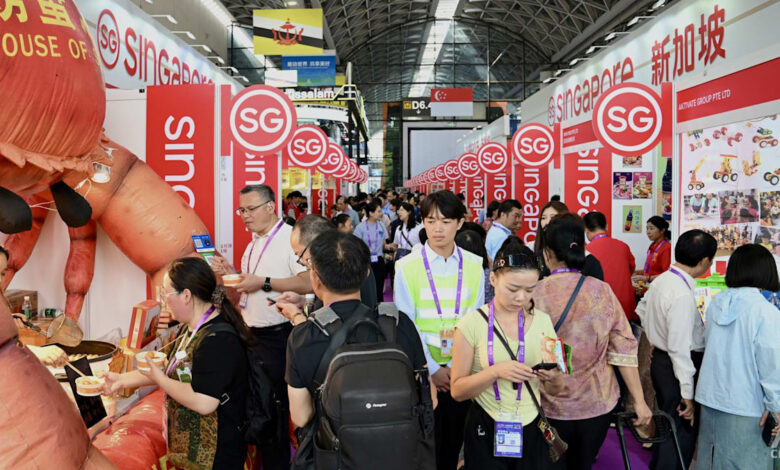
The logistical reality of this expansion is stark. Tracy Low, a 46-year-old sales director for Kim’s Duet, a company selling Singapore-style coffee in single-serve sachets, arrived in Nanning with a clear objective: finding a reliable distributor. Although the company began exploring the Chinese market earlier this year, Low noted that the process is far from immediate. “It could take between three to six months to filter these distributors before we engage them,” she said. This timeline underscores the difference between casual market testing and serious commercial engagement. While some participants at the expo were testing the waters for the first time, others, like KinderWorld, had spent years building contacts and turning discussions into tangible business deals.
The scale of the event itself reflects the deepening economic integration between the two blocs. The 23rd CAEXPO covered a total area of 170,000 square meters, an increase of 10,000 square meters from the previous edition. A total of 3,432 enterprises from 73 countries and regions participated, with international exhibitors accounting for 30.5% of the total. The focus on technology has grown significantly; the exhibition area dedicated to AI expanded by 60% from the previous edition, attracting 296 companies, a 48% year-on-year increase.
Wang Jicai, secretary-general of the China-ASEAN Expo Secretariat, highlighted that the event set up specific platforms to facilitate AI industry matchmaking between China and ASEAN. These efforts resulted in the unveiling of 42 AI application scenarios sought by ASEAN countries and generated nearly 100 preliminary cooperation agreements.
The potential economic value of these deals is substantial. According to the closing press conference, the intended value of deals with ASEAN countries exceeded one billion yuan (approximately $149 million). This surge in AI-focused cooperation suggests that the trade relationship is evolving beyond traditional goods and services into high-value technological integration. For Singaporean firms, this shift offers new avenues for entry, allowing them to position themselves as partners in the region’s digital transformation rather than just suppliers of consumer goods.
Despite the recent negative publicity surrounding the arrests in Nanning, the Singapore Business Federation (SBF) reported that it was not aware of companies raising concerns about entering the city following the news. Soo Wei-Chieh, executive director for international business at the SBF, stated that businesses continued to ask standard questions about “market access, market opportunities, and how they can enter a market.” This suggests that the business community is distinguishing between the isolated incidents of criminal activity and the broader, institutional framework of trade that the expo represents.
The conclusion of the expo and the ongoing participation in the 9th China-Nanning Overseas Talent Innovation and Entrepreneurship Competition, which concluded on September 22, signal a continued commitment to deepening ties. For Singaporean companies, the message is clear: the “blue ocean” of Guangxi requires patience and rigorous due diligence, but it remains a viable pathway for accessing the vast Chinese market. As the dust settles on the 23rd CAEXPO, the focus shifts from the handshakes and preliminary agreements in Nanning to the long, slow work of turning those connections into sustainable trade.