

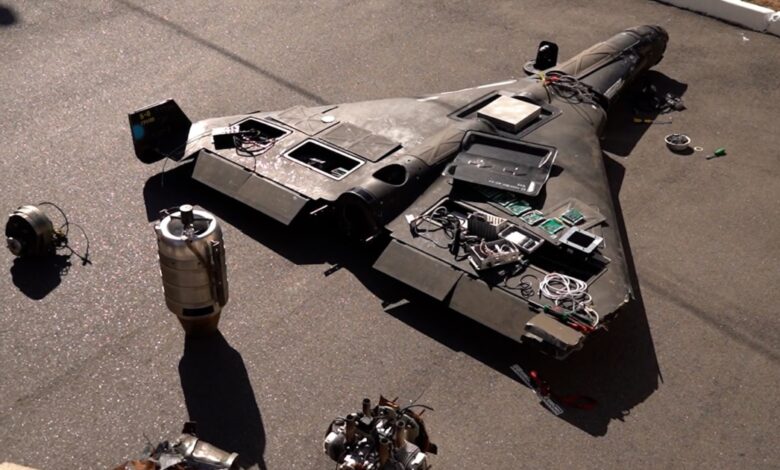
Zelensky disclosed that Russia plans to allocate $12 billion in 2027 specifically for the production of jet-powered drones and loitering munitions. This financial commitment underscores a strategic shift in Russian military procurement toward high-speed unmanned platforms. The introduction of jet-powered technology represents a significant tactical change, as these drones are faster and generally more difficult to intercept than their predecessors, which rely on conventional internal combustion engines.
Technical analysis of the Geran-4 drone reveals its enhanced capabilities stem from the integration of a turbojet engine, allowing it to operate at greater speeds and penetrate deeper into Ukrainian airspace. The platform incorporates advanced camera systems and utilizes foreign-made communications and navigation components to maintain operational effectiveness. These features contribute to the drone’s difficulty in detection and interception compared to earlier models.
Ukraine’s Defense Intelligence indicates that Russian industrial output for jet-powered kamikaze drones, specifically the Geran-4 and Geran-5 variants, has surpassed the production volume of Geran-2 strike drones. As of August, Russian facilities are manufacturing approximately 3,000 Geran-4/5 units and 2,800 Geran-2 units per month. This production surge suggests a sustained increase in the volume of high-speed threats facing Ukrainian air defense systems.
Counter-Measures and Interceptor Development
In response to the evolving threat, Ukraine is deploying several effective interceptor prototypes designed specifically to counter jet-powered drones. Zelensky confirmed that these systems are currently being used in combat conditions. He emphasized that specific interceptors have been identified as the primary means of defense, with production and component supply chains being scaled up to ensure a sustained response. The ultimate objective is to raise the interception rate for jet-powered drones to levels comparable to those achieved against conventional Shahed-type drones, which currently exceed 90%.
The disparity between the current 55% interception rate for jet-powered units and the 90% rate for conventional drones illustrates the technical challenge posed by the new Russian platforms. While the 55% figure indicates that Ukrainian air defenses are maintaining a significant level of effectiveness, the remaining 45% of successful penetrations represent a critical vulnerability that Kyiv is actively working to close through the deployment of next-generation interceptor systems.
The rapid scaling of both Russian production and Ukrainian counter-measure development marks a distinct phase in the conflict’s aerial warfare dynamics. The focus has shifted from countering slow-moving, long-range cruise missiles and conventional loitering munitions to engaging high-speed, jet-powered targets that require different detection and engagement tactics. The outcome of this technological race will likely determine the future efficacy of Russian long-range strike campaigns.