
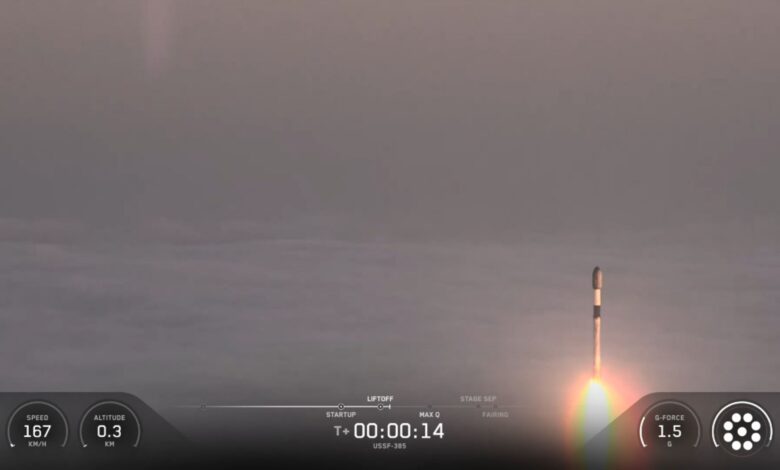
The first stage booster, designated B1100, executed its 10th flight, returning to Earth approximately 8.5 minutes after liftoff. The booster landed successfully on the SpaceX drone ship “Of Course I Still Love You,” positioned in the Pacific Ocean. In a standard protocol for sensitive government work, SpaceX cut off its public webcast shortly after booster touchdown, preventing viewers from seeing the deployment of the payload or the second stage. This operational opacity is consistent with previous classified missions, including USSF-153 and USSF-259, which launched from the same base on September 10 and September 16, respectively.
Analysts and industry observers believe these missions are dedicated to the deployment of Starshield, a variant of SpaceX’s Starlink satellite platform designed specifically for government and military use. The initial satellites for this particular constellation were launched aboard USSF-366 on August 15, with subsequent flights adding to the network. Although the Space Force has not provided technical specifications for these assets, the consistent cataloging of 23 satellites per launch for the first two missions in the series suggests a standardized deployment architecture. A later mission, USSF-259, placed 17 satellites into a different orbital plane, indicating flexibility in the constellation’s design.
The USSF-385 launch was the sixth and final Falcon 9 departure from Vandenberg in September. This frequency underscores a significant operational shift for SpaceX, which has increasingly designated the California site as the primary hub for its national security portfolio. Concurrently, the company is reducing its Falcon 9 cadence at Cape Canaveral Space Force Station in Florida, where only one Falcon 9 flew in September. The East Coast site is being repurposed to prioritize the development and testing of the Starship megarocket, a next-generation vehicle intended for heavier payloads and deep-space missions.
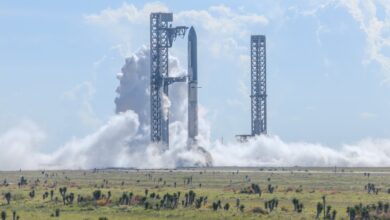
SpaceX’s overall launch cadence remains exceptionally high, with 108 Falcon 9 flights recorded in 2026 to date. The vast majority of these launches—approximately 75%—have been dedicated to building out the commercial Starlink broadband constellation, which now comprises more than 11,000 satellites in low Earth orbit. In addition to the 108 Falcon 9 flights, the company has conducted two launches each of its Falcon Heavy and Starship rockets this year. The next Starship test flight is scheduled for Monday morning, September 28, during a 75-minute window opening at 8:15 a.m. EDT (1215 GMT). This upcoming test is critical for the program, as it will attempt to reach orbit, a milestone the vehicle has not yet achieved.
The pace of these launches coincides with broader changes in the commercial satellite market. In May, SpaceX launched a batch of eight satellites for Globalstar, a company whose low Earth orbit constellation is being replenished as part of its long-term strategy. That mission was notable for setting a record for the shortest time between consecutive SpaceX launches, at just 38.5 minutes. Globalstar, which announced its intention to be acquired by Amazon in a deal expected to close in 2027, cited the launch as a crucial step in sustaining resilient satellite services. The Amazon acquisition would enable the integration of direct-to-device capabilities, allowing the constellation to compete in the growing space-based connectivity sector.
As the U.S. Space Force continues to rely on commercial providers for rapid satellite deployment, the USSF-385 launch reinforces the dual-track strategy of SpaceX: maintaining a high-frequency commercial satellite network while simultaneously executing classified government missions. The next phase of this activity will likely focus on the Starship test flight, which aims to demonstrate the vehicle’s orbital capabilities and further expand SpaceX’s capacity for both commercial and national security payloads.