The referendum is not a direct vote on independence, but rather a procedural step. The question posed to voters is whether Alberta should remain in Canada or hold a subsequent binding independence vote. This distinction has been central to the political maneuvering over the past year. Premier Danielle Smith, who leads the United Conservative Party (UCP), initially argued that a referendum was unnecessary. However, facing pressure from hardline supporters within her own party, she agreed to hold the vote. Smith has not campaigned in favor of independence, instead emphasizing the staggering costs associated with leaving the federation. In June, she estimated the transition cost at approximately C$400 billion (£212 billion), with an additional C$25 billion to C$50 billion in annual costs associated with establishing a new country.
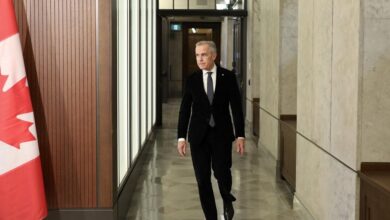
The high-profile opposition to separation has united figures who rarely appear side-by-side. Prime Minister Mark Carney, who grew up in Alberta and previously served as Governor of the Bank of England, traveled to the province last week to campaign for a united Canada. At a rally in Edmonton, Carney drew parallels to the economic upheaval following the United Kingdom’s Brexit vote, warning Albertans that a vote for separation would be a “dangerous bluff.” “At this pivotal moment, Albertans have a choice: to build a stronger Alberta and a greater Canada to leave for our children, or to burden them with years of deep division and great uncertainty,” Carney told the crowd. He emphasized that the frustrations felt by many Albertans regarding their relationship with Ottawa are real, but that separation would not address them.
Carney’s campaign was joined by former Premier Rachel Notley of the left-wing New Democratic Party and former Premier Jason Kenney of the right-wing Conservative Party. The appearance of these two former premiers, who have historically been bitter ideological rivals, signaled a consensus that the threat of separation transcends traditional partisan lines in Alberta. They were joined by Thomas Lukaszuk, a former deputy premier, who has campaigned for the “Forever Canadian” group, driving over 40,000 kilometers (24,855 miles) around the province in a motorhome to distribute lawn signs.
Supporters of separation argue that Alberta is short-changed by its financial relationship with the federal government and hindered from fully exploiting its vast fossil fuel reserves. Keith Wilson, one of the principal intellectual architects of the modern separatist movement, recently published a 214-page “Alberta transition plan.” Wilson dismissed comparisons to Brexit, asserting that the transition tasks are “absolutely doable” and largely “super easy.” He argued that negotiations with the federal government would be swift, stating, “It would be economic suicide for them to challenge Alberta,” and suggested that Canada could not survive without Alberta’s energy products.
However, the separatist movement is facing internal scrutiny and external legal obstacles. The movement has been marked by personal rivalries and allegations of misconduct among its leading figures. Jeff Rath, a lawyer linked to the Alberta Prosperity Project, is alleged to have mismanaged millions of dollars in First Nations trust funds. Additionally, David Parker, a longtime right-wing political organizer, remains under investigation following a voter-data scandal that exposed the personal information of nearly 3 million Albertans. Furthermore, in October, details emerged regarding meetings between unelected separatists and US officials, including allegations that they discussed directing oil royalties to the United States in exchange for assistance in establishing a new country.
Perhaps the most significant development in the lead-up to the vote was the intervention of First Nations groups, who successfully sued the Alberta government to force a change in the referendum question or its dismissal. Their legal victory was grounded in the fact that the land of modern-day Alberta is covered by five treaties signed with the Crown before the province’s creation. Troy “Bossman” Knowlton, president of the Blackfoot Confederacy, stated that these treaties are “living documents” with legal power, meaning Alberta does not have the unilateral constitutional right to separate. “The ignorance of the separatists, and their bigotry, does not allow their mind to accept the fact that [treaties] are not symbolic documents,” Knowlton said. He noted that after the legal victory, the province halted talks on land claims, which he viewed as an act of recrimination.
The atmosphere surrounding the vote was further complicated by a deadly fire at CFB Wainwright, a major military base in the province, which broke out on Saturday. The blaze caused multiple deaths and injuries, leading to a muted tone in the final days of campaigning. Despite this, the debate continues to highlight the complex intersection of provincial autonomy, federal control, and Indigenous rights. In Calgary, Mayor Jeromy Farkas warned of the “catastrophic impacts” of separation and the divisive nature of the debate, stating, “The unfortunate implication of separation is that it’s invited a conversation about who is a ‘real Canadian’?”
Monday’s ballot will also include nine other measures unrelated to separation, affecting social programs, judicial appointments, and the Senate. These additional questions have created further strategic confusion, with some remain supporters distributing “no to the nine” signs, while some separatists have launched a “decline the 9” campaign in protest of Premier Smith’s approach. Smith, for her part, has pushed a “yes to the rest” message. Regardless of the outcome, the referendum has already served to expose deep divisions within Alberta’s political landscape, challenging the notion of a unified provincial identity.
The next formal step will be the official tallying of votes on Monday. If the “remain” option wins, the issue of separation is expected to recede from the immediate political agenda, though the underlying grievances regarding energy policy and fiscal transfers will likely persist. If the “separation” option prevails, Alberta would be tasked with organizing a second, binding referendum, a process that would face immediate legal challenges from the federal government and First Nations leadership.