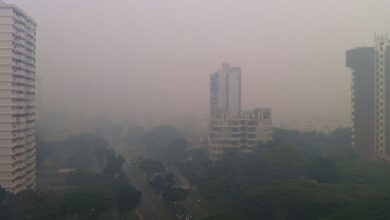
The strain on public health and daily life became most visible in the southern state of Johor, where industrial and coastal zones faced sustained pollution. On October 11, at 9 am, 15 areas nationwide recorded unhealthy API readings, with Pasir Gudang in Johor registering the peak value at 180. The contamination was not confined to a single point; seven other locations in Johor, including Larkin (178), Kota Tinggi (166), Tangkak (164), Segamat (162), Pengerang (160), Kluang (159), and Batu Pahat (151), all exceeded the unhealthy threshold. This widespread elevation in the south was mirrored, though with varying intensity, in other regions such as Pahang, where Balok Baru in Kuantan recorded 159, and Terengganu, where Kemaman and Kuala Terengganu both hit 156.
The persistence of these elevated readings triggered a direct policy response from the Education Ministry, acting on concerns raised by the Yang di-Pertuan Agong regarding the safety of students. The ministry issued a directive mandating the closure of schools and educational institutions in any area where the API exceeded 180, effective October 9. Furthermore, areas where readings remained above 150 for three consecutive days were required to close from October 12. This tiered approach reflects the seriousness of the exposure; while the API classification defines 101 to 200 as “unhealthy,” the government identified specific thresholds where the risk to health—particularly for children and vulnerable groups—necessitated a halt to in-person instruction.
The scientific basis for these closures lies in the composition of the haze itself. The API is calculated based on the 24-hour running average of the most dominant pollutant parameter, typically particulate matter (PM2.5 and PM10) resulting from combustion events. When these concentrations remain high for extended periods, the cumulative effect on respiratory and cardiovascular health becomes a significant public health concern. The Department of Environment (DOE) data showed that by October 15, the situation had shifted geographically while maintaining its severity. While Johor continued to struggle with five unhealthy areas—including Pasir Gudang and Batu Pahat registering 155 each—the epicenter of the highest readings had moved to Sarawak. On that Sunday, Serian’s reading of 194 was followed closely by Kuching (188) and Samarahan (182), indicating that the haze was affecting multiple climatic and geographic regions simultaneously.
The operational impact on the education sector has been substantial. Under the directive, affected schools were required to switch to home-based teaching and learning (PdPR). Education director-general Datuk Mohd Azam Ahmad stated that the ministry was acting to prevent exposure to air pollution that could harm health. Teachers and support staff were permitted to work from home, and state education departments were instructed to monitor air quality continuously. The decision was not a nationwide shutdown; rather, it was a targeted measure based on real-time data from the DOE’s Air Pollutant Index Management System (APIMS). The ministry emphasized the need to balance educational continuity with safety, ensuring that lessons continued through methods appropriate to students’ capabilities and access.
Across the country, the contrast between affected and unaffected areas highlighted the localized nature of the haze plumes. While 15 areas recorded unhealthy levels on October 11, 50 others remained in the “moderate” category (51–100), and three recorded “good” air quality (0–50). By October 15, the distribution had shifted slightly, with 47 areas in the moderate range and 10 in the good range. This variability underscores the complexity of transboundary haze, which is influenced by wind patterns, burning sources in neighboring regions, and local industrial activity. The presence of unhealthy readings in both the west coast (Johor, Negri Sembilan, Terengganu, Melaka) and the east coast (Sarawak) suggests that the meteorological conditions were trapping or transporting pollutants across diverse landscapes.
As the haze event continued, the focus remained on the health implications of prolonged exposure. The Education Ministry indicated it would continue to monitor developments and seek advice from the Health Ministry to ensure the welfare of students and education personnel. The data from early to mid-October reveals a period of sustained environmental stress, where the threshold for “unhealthy” air was breached repeatedly in key economic and population centers. For residents in areas like Pasir Gudang, where readings hovered near the upper limit of the unhealthy band, and in Serian, which approached the “very unhealthy” threshold of 201, the haze represented a tangible disruption to daily life, necessitating a shift from classroom instruction to digital learning and restricting outdoor activities.
The situation as of October 15 leaves the environmental outlook dependent on continued monitoring of the APIMS portal. With Sarawak’s Serian recording the national high, the pressure on the eastern seaboard has become acute, while the southern regions of Johor remain in a state of persistent moderate-to-unhealthy air quality. The government’s tiered closure policy will remain in effect as long as the API readings in specific districts exceed the stipulated limits of 150 or 180, linking the administrative response directly to the real-time scientific measurements of air pollution.