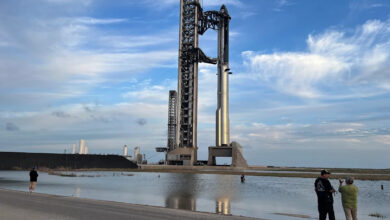
The mission, SpaceX’s 15th full-scale Starship flight since 2023, saw the 407-foot (124-meter) rocket launch from the company’s facility near the U.S.-Mexican border. The upper stage separated successfully from the first-stage booster and reached an orbital altitude of approximately 165 miles (265 kilometers). During its time in space, the vehicle completed 14 laps around Earth, significantly surpassing the one to two orbits achieved in previous test flights. While in orbit, the spacecraft deployed 26 advanced Starlink satellites.
Upon re-entry, the Starship demonstrated the functionality of its heat shield and other critical systems. SpaceX reported that the vehicle lowered itself upright, where it was secured by the “Mechazilla” launch tower arms. This technique, previously used only for catching the first-stage booster, now extends to the upper stage, reducing the need for a splashdown in the ocean. SpaceX commentator Dan Huot noted the significance of the event, stating, “Can you believe it? Look at her! Baby, she’s back!”
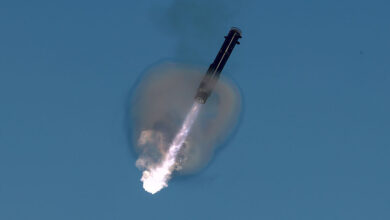
The mission did not achieve its goal of a “double catch,” as the first-stage booster failed to return safely. Shortly after liftoff, the booster’s engines shut down prematurely, causing it to deviate from its return path and explode, with wreckage falling into the Gulf of Mexico. The debris field has been cordoned off by buoys. SpaceX engineers are currently investigating the cause of the booster failure. Despite this setback, the company noted that it has previously made three successful booster catches, validating the general technique for the first stage.
NASA, which is funding Starship development for the Artemis program to land astronauts on the moon later this decade, welcomed the success. NASA Administrator Jared Isaacman described the event as “almost magic” and a step toward lunar goals. The successful capture of the upper stage is interpreted by SpaceX officials as proof of the vehicle’s potential for rapid reusability, which could lower the cost of deep space exploration. However, the booster failure highlights that the system is not yet fully stable for routine, reliable operations.
Next steps involve analyzing the booster data to identify the cause of the engine shutdown and continuing to refine the landing procedures for both stages. The successful orbital return of Ship 42 provides valuable data on the stresses of re-entry, while the booster investigation aims to restore the reliability needed for the planned fleet of Starships.