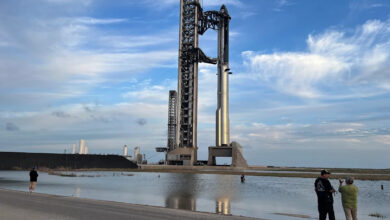
The Starship emerged from thick clouds over the Gulf Coast launch site, descending from an altitude of approximately 161 miles (260 km). After slowing from its orbital speed of roughly 17,000 miles per hour, the vehicle reignited three Raptor engines to flip from a horizontal orientation to a vertical position. It then slowly descended into the grasp of the tower’s “Mechazilla” arms, where it was secured by two protruding nubs on either side of the rocket. The spacecraft, charred from the heat of atmospheric reentry, shut down its engines and hung motionless in the arms.
This mission marked the longest flight for the Starship system to date. During the voyage, the upper stage deployed 26 Starlink satellites into orbit. The successful recovery demonstrates progress toward Elon Musk’s goal of creating a rocket system that can fly to space and return with the frequency and reusability of commercial airplanes. Currently, SpaceX’s dominant Falcon 9 rocket reuses its first stage but discards its second stage into the ocean after each flight; Starship aims to recover both stages in a single mission.

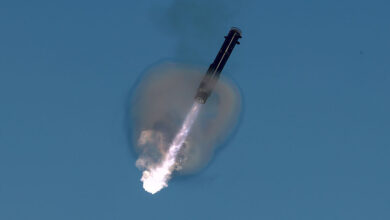
The mission was not without failure. The Super Heavy booster, the bottom half of the two-stage rocket, failed to return to the launch pad approximately 10 minutes after liftoff on Friday. The booster was destroyed, nixing the plan to recover both parts of the rocket for the first time. Despite this, the heat shield of the Starship upper stage performed well during reentry, indicating significant progress in the vehicle’s ability to withstand the intense thermal loads of atmospheric entry.
The catch was a precise maneuver, with the rocket aligning with the arms within less than a minute of becoming visible. This achievement follows a series of practice runs into the Indian Ocean. While this success validates the tower catch mechanism and reentry profile, SpaceX has yet to recover both the booster and the upper stage in a single mission. The next critical step involves refining the Super Heavy booster recovery to achieve full system reusability.