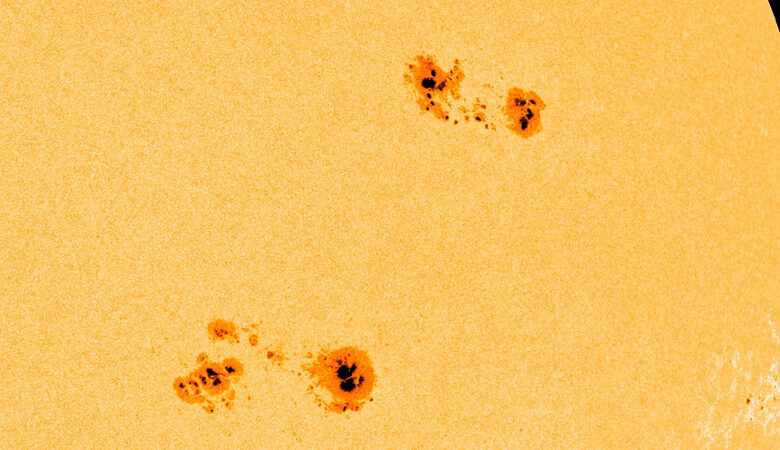
The solar activity was not isolated. Active Region 4513, classified as a complex beta-gamma-delta structure, produced four M-class flares within a 12-hour period on August 25. The sequence included an M1.9 flare at 01:26 UTC, an M1.0 at 04:02 UTC, an M1.8 at 06:40 UTC, and the peak M6.9 event. The M6.9 flare was accompanied by a Type II radio sweep with an estimated velocity of 603 km/s and a 10.7-cm radio burst of 160 solar flux units (sfu). The associated CME was first detected by the LASCO/C2 coronagraph on the Solar and Heliospheric Observatory (SOHO) satellite at approximately 11:00 UTC. Later that day, at 12:58 UTC, a C4.7 flare triggered a filament eruption that produced a second CME. SWPC determined that both ejections contain Earth-directed components and are anticipated to impact geospace on August 28.
In addition to the CMEs, a G1 – Minor Geomagnetic Storm Watch is in effect for August 27. This earlier disturbance is attributed to a positive polarity coronal hole high-speed stream, which is expected to begin affecting Earth around midday on the 27th. Solar wind speeds are forecast to increase to approximately 600 km/s during this period. The subsequent arrival of the CMEs on the 28th is expected to drive the storm to the G2 level, characterized by moderate geomagnetic activity. While G2 storms are generally less severe than G3 or higher events, they can still cause minor technological impacts, including potential disruptions to satellite operations and high-frequency radio communications. The magnetic field disturbances are also likely to energize atmospheric particles, making the aurora borealis visible at lower latitudes than usual, potentially reaching parts of the northern United States and Canada.

Forecast Uncertainties and Probabilities
Space weather forecasting relies on solar wind models and observations of solar activity to predict geomagnetic impacts. SWPC provides a 55% probability of R1–R2 radio blackouts and a 15% probability of R3 or greater activity for each day from August 26 through August 28, based on the ongoing flare potential of Region 4513. The center also notes a 10% probability of an S1 or greater solar radiation storm during this period. The greater-than-10 MeV proton flux has remained below the S1 threshold over the past 24 hours, indicating that radiation storm conditions have not yet materialized. Forecasts for specific arrival times and storm intensity remain subject to change as the CMEs approach Earth, with minor adjustments possible based on real-time solar wind measurements.
Previous solar activity in July also demonstrated the potential for complex geomagnetic interactions. In early July, Sunspot Region 4479, another beta-gamma-delta region, erupted with an X1.1 flare on July 1, launching a CME. While initial observations suggested the ejection was heading north of the Sun-Earth line, leading some analysts to predict a glancing blow, official forecasts at the time anticipated a G2 impact. This highlights the variability in CME trajectories and the challenges in predicting precise geomagnetic effects. The current August 28 forecast, however, is supported by direct coronagraph imagery confirming the Earth-directed nature of the August 25 ejections.
The upcoming geomagnetic storm serves as a reminder of the ongoing activity during the solar maximum phase. While the peak of the solar cycle may be approaching, the sun remains capable of producing significant space weather events. Monitoring of Active Region 4513 will continue, as it remains a key driver of current solar activity. Residents in northern mid-latitudes are advised to check local space weather updates for aurora visibility conditions, while satellite operators and communication providers should be prepared for potential minor disruptions associated with the G2 storm.