
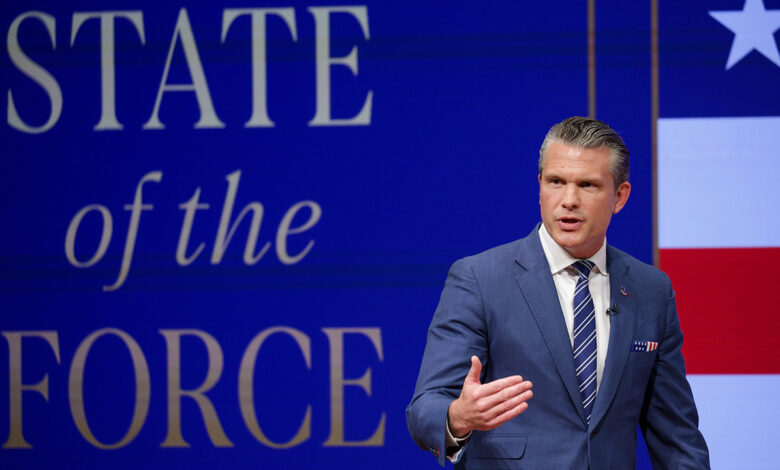
The proposed installation is described as a “fortress” spanning hundreds of thousands of acres, designed to house up to 25,000 service members. Hegseth stated that the base will feature organic power generation, operating entirely off the commercial grid, alongside modern air defenses and cutting-edge technology. The design aims to reject what he characterized as the legacy approach of spending heavily on advanced weapons systems while personnel live on aging bases with outdated infrastructure. The project aligns with an executive order on “Beautiful Civic Architecture,” which mandates that federal buildings and military installations be designed in timeless and classical styles.
To determine the location, the Department of War will launch a transparent process where governors present proposals directly to top military leadership at the Pentagon. The selection criteria prioritize the ability of a state to remove regulatory hurdles and bureaucracy to speed up construction, as well as the provision of land, community support, housing, schools, and other services. Hegseth emphasized that the process would be recorded and made public to eliminate political favoritism, describing it as a “straight-up, merit-based contest.” The winning state will be credited with hosting what the department’s press release termed “the most lethal, modern, and beautiful military installation on the planet.”

“For too long, our military has been bogged down by the same old tired Washington playbook: spending trillions on exquisite weapons systems, while our troops live in aging bases, outdated barracks, and with inadequate infrastructure. That era is over,” Hegseth said.
The announcement of the base was made during the same address in which Hegseth declared a further 20 percent cut to military leadership. He stated that the generals and admirals who remained were those who “responded positively” to his directives, while those who did not “no longer work here.” Hegseth addressed the cultural shift within the department, explicitly stating that it is “no longer the ‘woke’ department,” and used the phrase “no fatties, no trannies, no beardos, no weirdos, no wimps, no radicals” to describe the new personnel standards. He dismissed reports of low morale within the armed forces as “false claims” and asserted that the department is retaining service personnel at “record” rates.
In addition to the base construction and leadership changes, Hegseth unveiled several other strategic initiatives. These include the restoration of male physical standards and combat roles, a comprehensive review of military standards, an overhaul of complaint processes, and a focus on core training and maintenance. The secretary also announced “Project Meridian,” a study on the future of warfare led by Elon Musk, Newt Gingrich, and Palmer Luckey, and the creation of an Office of Religious Affairs that will report directly to the top of the department to “strengthen religious support.”

The events occurred against the backdrop of an active conflict with Iran, which has been ongoing for seven months. According to data cited by Al Jazeera, the war has resulted in the deaths of at least 22 U.S. service members and wounded more than 820 others, while killing more than 3,500 people in Iran. A 144-page field manual distributed to attendees at the speech included a foreword by President Donald Trump, who pledged not to send American soldiers into “dumb wars” while emphasizing the need to prepare for the wars of the future.
The next phase of the “Next Great American Base” initiative will involve the submission of proposals by state governors, with deliberations expected to be monitored for transparency. The Department of War has not yet specified a timeline for the completion of the selection process or the commencement of construction.