Trump further announced on Thursday that the U.S. has made “major progress” on plans to establish a permanent U.S. Army base in Poland. In a social media post shared by the White House, the president described the potential base as a “historic step” for the U.S.-Poland alliance, adding that the specific location would be announced once final decisions are made. The Pentagon has not yet released details on how it intends to fulfill the earlier order to boost troop presence, though some U.S. lawmakers have criticized the Department of Defense for moving too slowly and reducing brigade strength in Europe by 40% without Congressional support.
The diplomatic tensions surrounding the initial cancellation have been a source of significant concern in Warsaw. In May, Polish Prime Minister Donald Tusk and Defense Minister Kosiniak-Kamysz highlighted the strategic value of the U.S. military presence during a ceremony for a new Abrams tank engine servicing hub. Kosiniak-Kamysz noted that Poland has invested over $50 billion in U.S. weapon purchases, including fighter jets, helicopters, and missiles, and emphasized that the country contributes approximately $15,000 annually for each deployed U.S. soldier. “This reorganization cannot be made at the cost of the biggest ally of the United States in Europe,” he stated, arguing that existing deployments must remain intact.
The urgency of the U.S. military commitment is underscored by Poland’s assessment of the security environment. Prime Minister Tusk warned in parliament that there is a “real risk” that Russian drones or projectiles could enter NATO territory, potentially causing destruction. He cited intelligence suggesting Russia may portray such incidents as accidents to erode NATO’s willingness for a joint response. The threat is not hypothetical; on Sunday, a Russian drone struck a passenger train in Ukraine carrying foreign dignitaries, including senior European officials and former CIA Director David Petraeus, forcing an evacuation just miles from the Polish border. Another drone struck a truck at a nearby gas station, prompting Polish border guards to temporarily suspend cross-border traffic and enhance security.
In response to these threats, Poland has bolstered its own defensive posture. Defense Minister Kosiniak-Kamysz confirmed that engineering regiment soldiers are reinforcing border guard infrastructure along the Polish-Ukrainian frontier. These measures include the installation of Hesco bastions and new observation posts at three key border crossings: Dorohusk, Medyka, and Korczowa. Officials clarified that these actions are intended to secure border infrastructure and do not constitute a general military mobilization or large-scale buildup.
Concurrently, Polish recruitment centers have begun issuing annual mobilization cards to citizens. These documents assign reservists and civilian specialists in critical sectors—such as medical, IT, logistics, and energy—to specific units and locations. The instructions take effect only upon an official declaration of mobilization or martial law. Ignoring the requirement to report to a designated unit under such conditions carries a penalty of three years in prison. The cards use colored stripes to indicate the nature of the obligation, with red stripes designating reservists required for immediate active service.
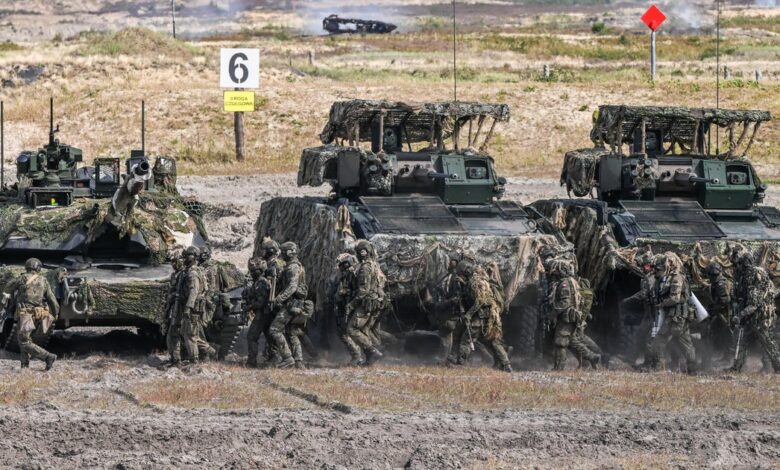
The resumption of the U.S. rotation, likely involving a Fort Hood-based armored brigade, aims to restore the rotational presence of approximately 10,000 U.S. soldiers currently stationed in Poland. The next phase of the deployment is expected to be completed within weeks, while the finalization of the permanent base location remains under active negotiation between Washington and Warsaw.