
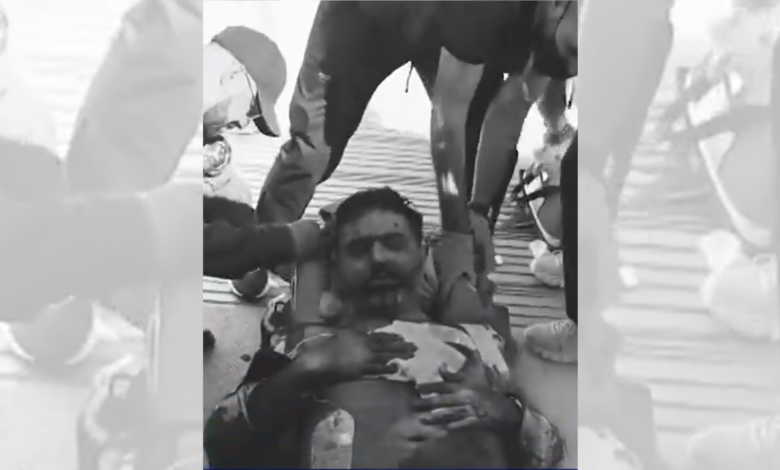
Captain Smit Machchhar, an Indian national, sustained serious injuries in the attack but managed to unlock the cockpit door, allowing passengers and off-duty crew members to intervene. Among those who rushed into the cockpit was Yaniv Hayun, an off-duty pilot who described confronting the attacker in a “do-or-die” situation. Hayun stated that he restrained the co-pilot and helped stabilize the controls, enabling the remaining on-duty crew to execute the emergency landing.
“I grabbed the attacker, and choked him, pulled him out first,” Hayun said. “I started pulling the controls. Thank God, we pulled it off. We really put our heads together and worked as a team.”
Flight data indicated the plane lost significant altitude rapidly, with one segment showing a drop of over five kilometers in 29 seconds. Passengers aboard, all of whom were Israeli nationals, described the terror of the moment. Aviatar Alevi, 17, recounted hearing screams and seeing blood, noting that the possibility of death “was definitely an option.” The flight carried approximately 180 people, including four dual U.S.-Israeli citizens.
Israeli Prime Minister Benjamin Netanyahu characterized the incident as a likely suicide attempt or terrorist act, rather than a traditional hijacking. While acknowledging that it is too early to determine the precise motive, Netanyahu noted signs that Iran and its proxies have sought to heighten attacks against Israeli nationals abroad. Israeli Defense Minister Israel Katz went further, branding the event a “jihadist terrorist attack attempt,” though he did not provide immediate evidence for this classification.
Investigations are currently being led by Saudi authorities, where the injured captain is recovering in a hospital and the Omani co-pilot is being interrogated. A senior U.S. official briefed on the matter indicated that early findings increasingly suggest the stabbing was an act of terrorism. However, the Saudi Embassy in the U.S. stated that authorities are still determining whether the incident was a dispute between pilots or an act sponsored by Iran or the Houthis. The diplomatic relationship between Israel and Saudi Arabia remains non-existent, adding a layer of complexity to the cross-border investigation.

The incident has triggered heightened security protocols in the region. Reports indicate that Israeli fighter jets were scrambled in response to the distress signal, preparing for a worst-case scenario as the plane descended. The rapid intervention by passengers and crew is being credited with preventing a mass casualty event, though the psychological impact on the survivors remains significant. As the plane arrived at Ben Gurion Airport, passengers were greeted by media and flag-waving citizens, having survived what witnesses described as a terrifying mid-air plunge.
Questions surrounding the co-pilot’s background and potential radicalization remain central to the ongoing inquiry. Netanyahu suggested the suspect may have undergone Islamist indoctrination, a claim that awaits verification through the debriefing of all parties involved. Until further details emerge, the incident stands as a stark reminder of the vulnerabilities in international air travel and the unpredictable nature of threats targeting Israeli citizens abroad.