
According to official announcements, five of these new Kodams are scheduled to become operational by 2025. The expansion is not merely administrative; each new Regional Military Command typically oversees two to three sub-regional commands (Korem) and multiple infantry battalions, along with specialized units including engineers, cavalry, and field artillery. Below the Kodam level, the establishment of a sub-regional command usually precedes the creation of a military district command (Kodim), which functions as the Army’s primary territorial unit at the district level. This cascading structure ensures that the expansion of high-level commands results in a denser network of military presence across the archipelago.
Concurrent with the command expansion, the Army has outlined plans to form 100 Territorial Development Battalions by 2025. Defense Minister Sjafrie Sjamsoeddin, a four-star general, announced this initiative during a working meeting with the House of Representatives in November 2024. These units are designed to possess dual capabilities: in addition to standard combat functions, they will include specialized sub-units focused on agricultural development, livestock, fisheries, and health services. The stated objective is to support local development in every district, a concept described by domestic media as the military’s “soft power.”
The strategic priority behind this expansion is closely linked to the administration of President Prabowo Subianto, who served as Defense Minister prior to his presidency. A key focus is the South Papua region, which hosts 2.6 million hectares of food estates. These estates are central to the government’s food security initiatives, specifically the “free nutritious meals” program, and energy security goals involving palm oil and biofuel plantations. To support this, three combat battalions comprising 2,100 personnel have already been established and deployed to Merauke in South Papua. These units augment five new units designated for the broader Papua region, with the remaining two battalions slated for deployment in West Papua and Southwest Papua.
While the official justification for the expansion cites the need for enhanced national defense and improved territorial management, critics argue that the scope of the changes suggests a potential return to the doctrine of “dual function” (dwifungsi). Historically, dwifungsi positioned the military as a dominant force in both defense and civilian governance. The current push to integrate development roles directly into combat units, combined with the proliferation of territorial commands, has led analysts to question whether the TNI-AD is strengthening national security infrastructure or blurring the line between military and civilian roles.
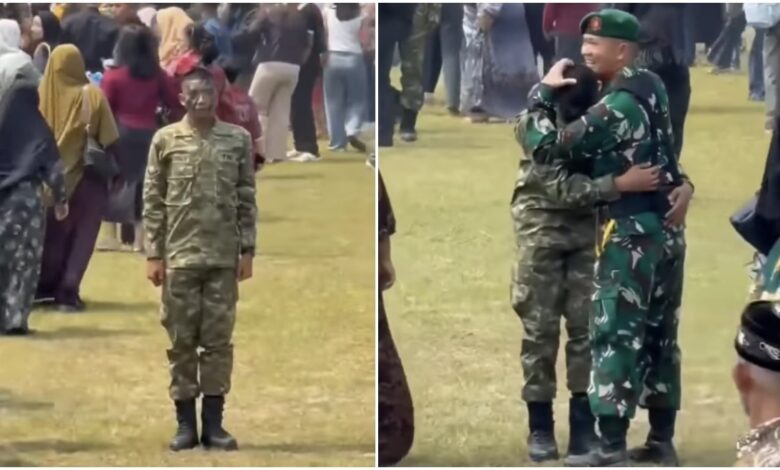
The human dimension of this military structure was highlighted recently during the closing ceremony of the First TNI AD Education, a training program designed to transform civilians into professional soldiers. In a widely shared video, a commander was seen approaching a recruit who stood alone during the graduation, separated from the families and friends gathered around his fellow soldiers. The commander embraced the recruit, who broke down in tears, a moment that drew widespread online praise for the officer’s compassion. Army Chief of Staff General Maruli Simanjuntak has simultaneously stated that the recruitment process for Army personnel is now more transparent, inclusive, and free, aiming to project an image of a modern and accessible institution.
As the Army moves toward its 2025 milestones, the tension between its traditional defensive mandate and its new developmental responsibilities remains a focal point of domestic political debate. The next major indicators of this shift will be the operational status of the first five new Regional Military Commands and the full deployment of the 100 development battalions across Indonesia’s districts.