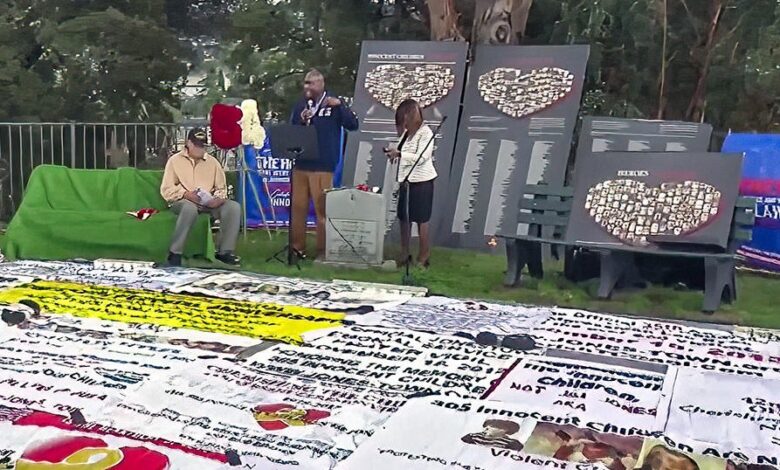
The central legal and ethical friction at the cemetery centers on the memorial plaques erected for the victims. Many plaques list the deceased in alphabetical order, a factual record of those who perished. However, this list includes the name of Jim Jones, the leader of the Peoples Temple. Survivors and family members of the victims argue that inscribing the name of the individual responsible for orchestrating the deaths constitutes an insult. Yulanda Williams, a retired San Francisco police captain and former member of the Peoples Temple, attended two remembrance events at the site. Williams, who is a survivor, described the conditions in Jonestown as those of an “active concentration camp” where residents were guarded 24/7 by armed security officers. She emphasized that the victims were innocent and did not willingly take the poison, characterizing the event strictly as a massacre.
The legal and historical record of the event is complex, involving both the initial intrusion by a congressional delegation and the subsequent coordinated taking of lives. In November 1978, a delegation led by Congressman Leo Ryan traveled to Guyana to investigate allegations that members of the Peoples Temple were being held against their will. As the delegation prepared to return to the United States, they were ambushed by armed followers of Jones at the airstrip. Five people were killed in the gunfire, including Congressman Ryan. Representatives and journalists who survived the ambush, including then-aide Jackie Speier, described being shot and left for dead. Speier, who was 28 years old at the time, stated that she pretended to be dead, surviving after being shot five times. She was eventually airlifted to the United States, where she underwent at least ten surgeries.

Simultaneously with the ambush on the delegation, Jones issued orders to his followers at the Jonestown compound. According to survivor Laura Johnston Kohl, Jones warned that the Guyanese military would invade and seize their children in retaliation for the airstrip shooting. Kohl, who was in Georgetown, Guyana, at the time, recalled receiving a radio message stating that everyone in Jonestown was dying or dead and that others needed to commit “revolutionary suicide” immediately. The order was carried out through the distribution of vats of fruit punch laced with cyanide. Kohl noted that Jones had cultivated an environment of paranoia and dependency, telling followers they had no recourse outside the community because they had invested all their resources in the church. Two of Jones’ children, who were visiting the capital, refused to follow the suicide order and instructed other branches of the Temple to disregard the command, a deviation that may have saved lives in locations outside the main compound.
The aftermath of the event has left a lasting impact on the families of the victims. Jynona Norwood, who lost 27 family members, including her mother and a two-month-old cousin who was the youngest victim, spoke of the generational loss. “We lost generations. We lost babies. We lost seniors,” Norwood said. Her statement underscores the breadth of the demographic affected, ranging from infants to the elderly. This loss is the basis for the current campaign to remove Jim Jones’ name from the memorial plaques. Norwood argued that honoring Jones alongside the victims was “ludicrous” and “insensitive,” stating that one must be in denial to insist on such a memorial arrangement.
In contrast, other survivors and family members have taken a different stance on the issue of the plaques. Survivor John Cobb argued that the alphabetical listing serves as a point of history that cannot be altered. “Whoever died that day, their names are in alphabetical order on those plaques as a point of history,” Cobb said. He contended that erasing the names of those responsible for the violence would not change the historical facts of the event. “You can’t change history as much as you want,” Cobb stated, suggesting that the presence of Jones’ name is a factual record of who was present and died, regardless of their culpability in the deaths of others. Both sides of this debate, however, agree on the necessity of learning from the tragedy to prevent similar abuses in the future.

The legal and social implications of the Jonestown incident extend beyond the immediate deaths. The event has long been cited in discussions regarding the regulation of religious and ideological groups that operate in secrecy. Survivors like Speier have spoken to the need for vigilance against organizations that isolate members from the outside world. The specific allegations of abuse and confinement that prompted the congressional investigation highlight the tension between religious freedom and state protection of individual liberty. The fact that a member of Congress was killed while performing his duty to investigate these claims added a significant political dimension to the tragedy, drawing national attention to the plight of the cult members.
Today, the dispute over the memorial plaques remains unresolved, reflecting the deeper difficulty in reconciling historical record with moral judgment. For the families, the presence of Jones’ name is a source of ongoing pain, while for others, it is a matter of historical integrity. The gathering at Evergreen Cemetery serves as a recurring site for this negotiation, where the public memory of the 1978 massacre is actively constructed and contested. As the anniversary marks another year of remembrance, the focus remains on ensuring that the victims are not forgotten, while the legal and symbolic status of the perpetrator remains a point of division among the community of survivors.