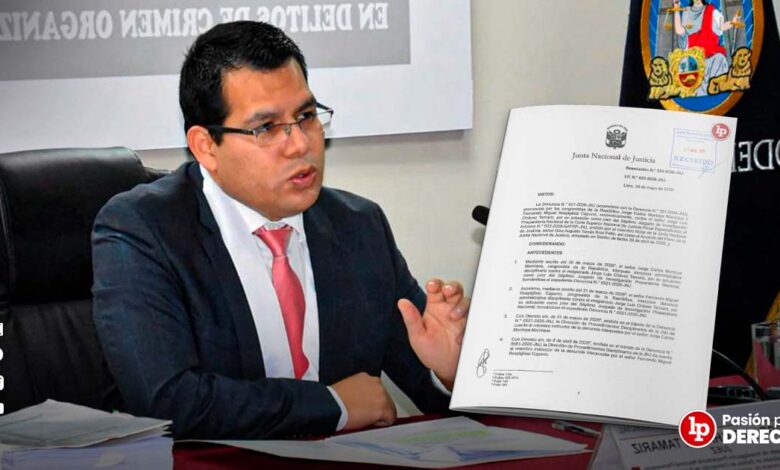
Law 32107 defines the application and scope of crimes against humanity and war crimes in Peruvian legislation. The complainants argue that the judge exceeded the boundaries of constitutional control because the Constitutional Court had previously confirmed the validity of the law, declaring demands for its unconstitutionality unfounded in Sentence 190/2025. The JNJ noted in its resolution that judges “cannot refrain from applying a norm whose constitutionality has been confirmed in an unconstitutionality process.” Additionally, the board is evaluating the language used in the judge’s decision. The initial complaint highlights the use of comparisons to the Nazi regime, the Nuremberg trials, and Adolf Eichmann, as well as philosophical concepts like “absolute evil,” to justify the ruling. The JNJ indicated that these expressions may constitute an inappropriate use of judicial language and a breach of the institutional prudence and respect required in the jurisdictional function.
The potential disciplinary findings could result in charges for very serious infractions under Articles 47 and 48 of the relevant disciplinary law. This development occurs against a backdrop of significant political tension regarding the JNJ’s independence. In March 2024, the Peruvian Congress approved resolutions to accuse and disqualify two JNJ members, Luz Inés Tello de Ñecco and Aldo Alejandro Vásquez Ríos, for ten years from public office. The vote to accuse Tello de Ñecco passed with 67 votes in favor, 23 against, and three abstentions, while the vote against Vásquez Ríos passed with 67 in favor, 22 against, and one abstention.
International human rights organizations, including Human Rights Watch and WOLA, expressed concern over these legislative actions. They warned that the removal of board members through politically motivated processes threatens the pillars of Peru’s democratic system and the protection of human rights. The United Nations system in Peru also voiced concern, stating that the separation of powers is a fundamental principle for full democracy. The JNJ had previously characterized efforts to remove its members without established procedures or typified causes as a threat to the constitutional order.
While the current investigation focuses on the conduct of a specific judge, it underscores ongoing debates about the limits of judicial power and the independence of the JNJ. The JNJ holds the authority to appoint, evaluate, and remove judges and prosecutors, as well as the heads of electoral bodies such as the National Office of Electoral Processes (ONPE) and the National Registry of Identification and Civil Status (RENIEC). The outcome of this disciplinary process is not yet determined, but it will test the board’s capacity to enforce disciplinary standards within the judiciary amidst broader political pressures on the institution.