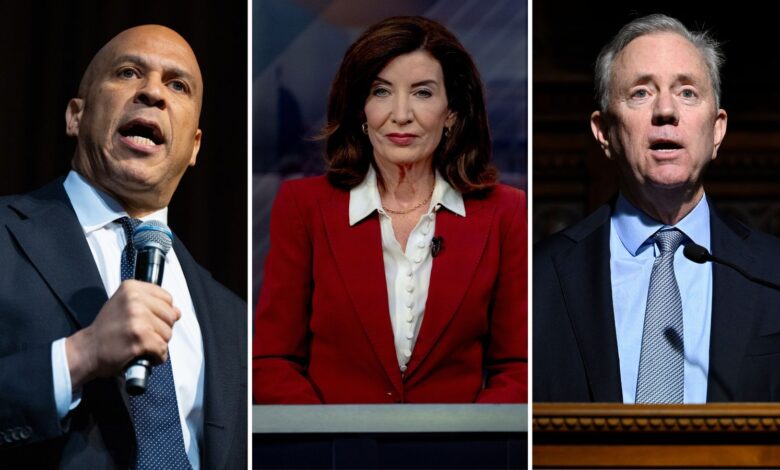
The political significance of the New York result extends beyond the gubernatorial office. With Hochul securing a roughly 20-point victory over Republican challenger Bruce Blakeman, the state’s top two executive offices will now both be held by women. Hochul, who became New York’s first female governor in 2021, had campaigned with Adams as a ticket, frequently highlighting the opportunity for historical representation. During her victory speech, Hochul addressed the constituents who returned her to office, stating, “Serving you has taught me that leadership isn’t about just having the courage to make the tough calls… it’s about the humility to go through it all and I answer to you, the people of New York!”
The gubernatorial race was one of several high-stakes contests that defined the midterm election cycle. According to projections from ABC News, Democrats won key races across the Tri-State area and nationally. In New Jersey, incumbent U.S. Senator Cory Booker was projected to win reelection. In Connecticut, Democrat Ned Lamont was called the winner in the gubernatorial race, securing his third term in office. These victories contributed to the broader projection that Democrats would assume control of the Senate and the House of Representatives, a shift that will alter the legislative landscape in Washington, D.C., for the next two years.
On the congressional level, Democrats scored notable victories in two closely watched districts. In New York’s 17th Congressional District, Cait Conley defeated incumbent Representative Mike Lawler. Conley, an Army veteran and former national security official, accepted Lawler’s concession on election night. Lawler, who had represented the district since 2023, was seeking a third term. The race in Westchester County was complicated by logistical issues on Election Day, as scanner problems forced many voters to place ballots in secure emergency bags rather than using voting machines. Election officials maintained that these ballots remained secure and would be counted, ensuring the integrity of the final tally.
Similarly, in New Jersey’s 7th District, Rebecca Bennett was projected to defeat Representative Tom Kean Jr. Bennett, a former Navy helicopter and test pilot, claimed the seat in a district that had previously leaned toward the incumbent. These flips in competitive suburban districts mirrored the national trend of Democratic gains in House races.
While the gubernatorial and congressional results were projected early in the night, the state-level legislative races continued to unfold. The New York State Board of Elections reported that all 150 State Assembly seats were on the ballot. Of these, 106 districts were contested, while 44 candidates ran unopposed. Incumbents sought reelection in 119 districts, leaving 31 seats open. As of 1:32 a.m. ET on November 4, the Board was compiling results district by district, noting that absentee, affidavit, and military ballots counted after election night were not yet included in the preliminary figures.
The process of determining the final composition of the State Senate and Assembly is distinct from the federal races, requiring a district-by-district count that often extends past the initial call of the governor’s race. The outcome of these legislative races will determine the internal balance of power within the New York state government, influencing the ability of the executive branch to enact its agenda. The involvement of nonpartisan newsrooms, such as New York Focus, has emphasized the importance of tracking these 150 individual contests to provide a transparent view of how the state’s lower house will be configured.
The combination of a Democratic sweep in the federal government and a strong Democratic hold in New York state leadership sets the stage for a period of aligned governance at both the state and federal levels. For Governor Hochul, the victory ensures continuity in her administration, allowing her to pursue her legislative priorities without the distraction of a contested re-election. The historic nature of the all-female executive team adds a symbolic dimension to the political reality, marking a shift in the demographic representation within New York’s highest offices.
Uncertainties remain regarding the final certified results in the State Assembly, particularly in the 106 contested districts. The count of late-arriving ballots, including those placed in emergency bags in Westchester County and those mailed late, will be crucial in finalizing the margins in close races. However, the broad strokes of the political landscape appear clear: Democrats have consolidated power in New York and expanded their control in Washington, positioning themselves to pursue their legislative agenda in the coming session.
As the night progresses, attention turns to the specific district results that will finalize the map of the New York State Legislature. The next political development will be the official certification of these state legislative races, which will determine the exact majority or minority status of each party in the Assembly and Senate, thereby defining the immediate operational dynamics of the state government.