
The reversal was not merely a corporate decision; it was the culmination of intense diplomatic and political intervention. According to sources familiar with the discussions, top officials of the U.S. administration provided direct assurances to the Nvidia board that Huang was not facing criminal charges. Despite U.S. intelligence assessments suggesting Huang had an affair with a woman believed to be a Chinese intelligence asset, officials argued he did not pose a national security risk. These assurances, detailed in reports from the New York Times and ABC News, appear to have been the decisive factor in the board’s sudden change of heart, occurring moments before the 9 a.m. market open.
President Donald Trump, who had publicly urged Huang’s return, claimed personal responsibility for the outcome. In a phone interview with CNBC, Trump stated that he had spoken “directly and indirectly” to board members, asserting, “I convinced them. I made the deal.” Nvidia’s official statement confirmed that the board received “input from senior levels of the United States government.” This level of executive influence on a major corporation’s leadership structure raises significant questions about the independence of corporate governance, particularly for a company whose products are central to U.S. technological advantage.
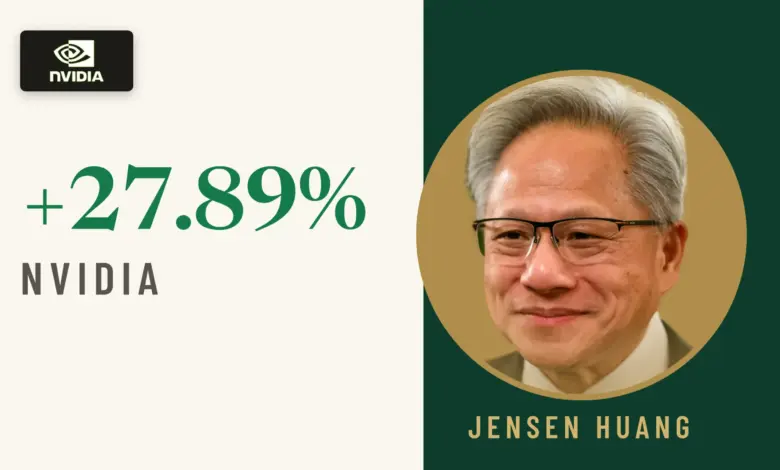
The financial mechanics of the event were staggering. Nvidia shares, which had closed at $125.53 the previous Friday, jumped 27.89% in early trading to $160.54, eventually closing up 31.5%. For Jensen Huang, the reinstatement added approximately $34 billion to his personal fortune, according to Forbes’ real-time billionaires list. The rally also lifted the broader market, with the Dow Jones Industrial Average closing up more than 3.0% and the tech-heavy Nasdaq soaring over 6.5%. The recovery was swift; Nvidia shares recovered nearly all losses suffered since the resignation was announced on November 12.
The impetus for the original departure was a matter of alleged misconduct and national security. Huang had resigned citing “personal behavior inconsistent with the company’s code of conduct.” On November 17, the board had stated it did not “intend to reinstate Jensen as CEO.” However, the underlying business fundamentals had remained robust through the turmoil. In its third quarter of fiscal 2027, Nvidia reported revenue of $115.84 billion, a 103.2% increase year-over-year, beating consensus estimates of $108.73 billion. Non-GAAP earnings per share came in at $2.68, exceeding the $2.47 estimate. Management guided fourth-quarter revenue to $130 billion, signaling continued expansion.
Central to the bull case for the stock’s recovery is the rapid adoption of Nvidia’s next-generation hardware. In its first quarter of shipments, the Vera Rubin chip generated nearly $20 billion in revenue. Management described this as “the fastest product ramp in Nvidia’s history.” Consequently, the company raised its fiscal 2028 revenue growth outlook to approximately 75%. Analysts have responded by raising their forecasts; consensus fiscal 2028 EPS has climbed to $16.60 from $12.99 just 90 days ago. The Street’s average price target stands at $244.18, with a bull case reaching $263.01. Despite the recent volatility, the stock remains well below its 52-week high of $243.37, having lost nearly 40% of its value from late August to Friday’s close.
However, the rally faces technical and commercial headwinds. Fourth-quarter gross margin guidance of 71% to 72% is lower than the 74.9% recorded in the prior quarter, suggesting potential pressure on profitability as the company scales production of the Vera Rubin platform. Furthermore, the political dimensions of Huang’s return introduce a layer of uncertainty. The involvement of the White House in resolving a corporate leadership dispute sets a precedent for how national security concerns may be weighed against executive performance in the AI sector. For investors, the distinction between a business driven by chip demand and one influenced by political maneuvering remains a critical variable.

The immediate impact of the reinstatement is visible in the broader economic landscape. The surge in Nvidia’s valuation lifted the wealth of its employees and boosted stock prices across the U.S. and Asia, with Europe experiencing a smaller, secondary boost. The event also affected the holdings of U.S. President Trump, whose accounts held between 32,000 and 370,000 Nvidia shares as of September 30, according to a Financial Times analysis. While the White House maintains that these accounts are managed independently by third-party institutions using computer-based models, the timing of Trump’s public advocacy for Huang’s return and the subsequent stock surge has drawn scrutiny regarding potential conflicts of interest.
As the market digests the largest one-day gain in its history, the focus shifts back to execution. With the leadership question resolved, the next test for Nvidia is the continued scaling of the Vera Rubin ramp. The company must now translate its technological lead into sustained revenue growth while navigating the complex geopolitical landscape that nearly cost it its founder. The reinstatement of Jensen Huang has stabilized the stock, but the interplay between U.S. government interests and private sector innovation remains an unresolved tension in the story of American artificial intelligence.