
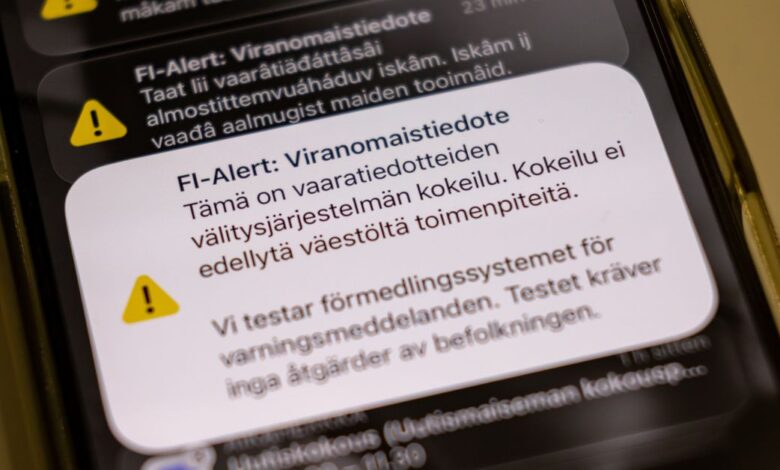
The primary objective of the test is to counter information warfare and verify that the emergency warning infrastructure functions reliably across all official channels. According to the Ministry of the Interior, the exercise is broader than previous trials, testing the entire ecosystem of warnings, which includes mobile phones, television, radio, teletext, and the 112 Suomi application. Minister of the Interior Mari Rantanen emphasized the strategic importance of the system, stating, “It is very important that we will be able to warn the public more quickly, reach more people and target warnings to specific areas.”
FI-Alert utilizes cell broadcast technology within mobile networks to send geographically targeted alerts. Unlike standard notifications, which can be muted or suppressed by user settings, the 24 November test is designed to override device silence modes. The only way to avoid the 10-second alarm is to switch the phone off or place it in flight mode for the duration of the test. This distinction is critical for the system’s intended purpose: ensuring that warnings for situations threatening life, health, or major property damage penetrate through to the user regardless of device configuration.
However, the rollout of this technology is not yet universal. The system currently operates only on 4G and 5G phones connected to a mobile network. Authorities have noted that software updates are being rolled out in stages, meaning the system does not yet function on all compatible devices. If a user does not receive the alert, it may be due to an outdated operating system or the need for a device restart after an update. Consequently, the test serves not only as a functional check for the state but also as a diagnostic for the population, identifying gaps in device compatibility.
The scope of the 24 November test is comprehensive but not total. Messages will be issued in Finnish and Swedish, and for the first time, in English. This multilingual approach is significant for a country with a substantial non-native population and a high number of visitors, as alerts will reach compatible phones even if the mobile service is provided by a foreign operator. However, due to technical issues encountered in a smaller test held the previous week, messages in Sami languages will be excluded from this specific exercise. Additionally, reception will be switched off for children’s XGO3 smartwatch phones. In contrast, a prior test on 17 November was limited in scope; it followed individual phone notification settings, meaning it would not sound if the phone was on silent, and did not play the mandatory emergency warning tone.
The distinction between the 17 November test and the 24 November exercise highlights the progression of Finland’s emergency preparedness. The earlier test was a limited check, while the 24 November event represents a full-system stress test. The government allocated funding last year to develop and launch this system, aiming to complement rather than replace existing warning channels. Warnings will continue to be issued via radio, television, and websites, but FI-Alert adds a direct, targeted digital layer to the communication stack.
For the public, the implications are practical and immediate. No action is required upon receiving the notification, and no app or settings changes are needed to participate in the test. The 10-second alarm is intended to be noticeable and urgent, reflecting the severity of the alert level being simulated. This approach aligns with global trends in civil defense, where the speed and reach of information distribution are viewed as critical components of resilience against both natural disasters and human-made threats.
The reliability of FI-Alert is contingent on several factors, including network coverage, device compatibility, and user behavior. While the system is designed to be robust, the phased rollout of software updates means that a portion of the population may not receive the test alert. This underscores the importance of the multi-channel strategy, where traditional media and apps serve as backups to the digital cell broadcast. The exclusion of certain languages and device types, such as the XGO3 smartwatches and Sami-language messages, highlights the current technical limitations of the system, which authorities are working to address in subsequent phases.
As Finland prepares for this nationwide test, the focus remains on ensuring that the public is informed and prepared. The 24 November exercise will provide valuable data on the system’s performance, offering insights into its effectiveness in real-world conditions. For policymakers, the results will inform future enhancements to the emergency warning infrastructure, ensuring that it can adapt to evolving threats and technological advancements. The test is a clear signal of the government’s commitment to enhancing national security and public safety through modern, efficient communication channels.