
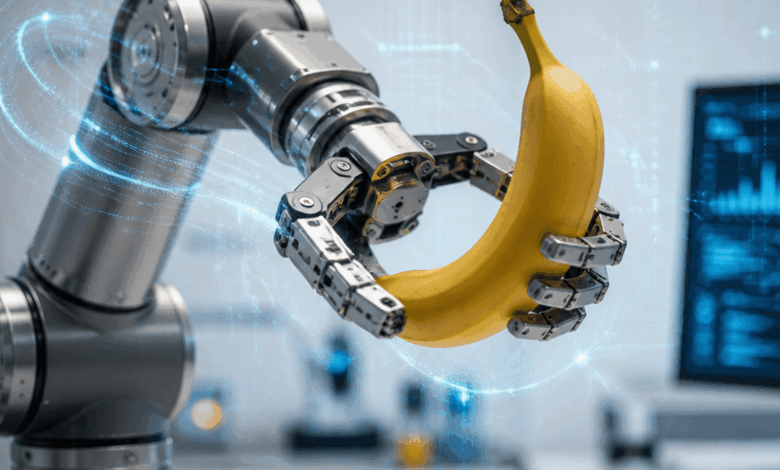
The capability is distinct from the industrial robots that currently dominate factory floors, which excel at repetitive tasks but fail when conditions deviate slightly from their programmed expectations. Moving an object two inches from its designated position or altering lighting conditions can cause traditional computer vision systems to struggle. In contrast, Generalist AI’s platform demonstrates generalization, transferring knowledge across contexts to recognize that a banana, a stick, or a rolled-up magazine might serve similar functional purposes. This approach mirrors the learning processes of toddlers, who explore through trial and error to build intuitive physics models rather than memorizing specific instructions.
This development occurs as the artificial intelligence industry pivots from purely digital intelligence to physical embodiment. While major technology firms have focused on large language models that process text and images, the next frontier involves machines that can navigate and manipulate the unpredictable physical world. The technical architecture behind Generalist AI’s demo likely combines vision transformers for 3D scene understanding, reinforcement learning algorithms for experiential learning, and foundation models that provide broad world knowledge to reason about novel objects.
The competitive landscape for physical AI includes several major players with distinct strategic approaches. Tesla is developing its Optimus humanoid robot with ambitions for general-purpose automation, while Amazon continues to invest in warehouse robotics capable of handling the diverse range of products flowing through fulfillment centers. Apple has also explored robotics projects, though the company maintains secrecy regarding its specific plans. However, startups like Generalist AI may possess an advantage in innovation speed. Unencumbered by legacy systems and the bureaucratic constraints of large organizations, smaller teams can iterate more rapidly on novel architectures, potentially allowing them to achieve breakthroughs with fewer resources than their corporate counterparts.
The practical implications of this adaptive technology span multiple industries. In manufacturing, robots that adapt to product changes without expensive reprogramming could streamline production lines. In logistics, systems that handle packages of varying sizes and shapes could improve warehouse efficiency. There is also the potential for home robotics to move beyond limited functions, offering more useful assistance in domestic environments. The timing of this breakthrough is significant, as the convergence of affordable sensors, powerful edge computing, and context-aware AI models has finally made such adaptive systems viable, moving beyond the decades of hype cycles that previously promised human-like machines but delivered limited results.
Despite the promising demonstration, significant challenges remain before widespread adoption. Real-world environments are far messier than controlled laboratory settings, and safety concerns increase when robots make independent decisions in proximity to humans. Additionally, the computational requirements for running sophisticated AI models on robotic hardware remain substantial. The banana demonstration serves as a symbolic threshold, proving that machines can learn to improvise rather than just execute predefined routines. As robots transition from following scripts to thinking on their feet, the boundary between human improvisation and machine capability continues to blur, suggesting that the future of automation may look less like rigid factory precision and more like creative problem-solving.