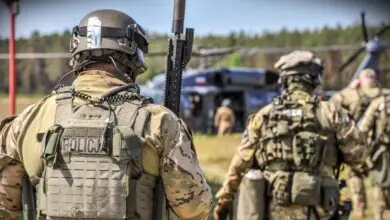
The trip, which was kept under wraps for security reasons, places Zelenskyy at the center of a dense diplomatic calendar. He is scheduled to meet with German Chancellor Friedrich Merz, President Frank-Walter Steinmeier, and Bundestag President Julia Kloeckner. Additionally, the Ukrainian leader will participate in the two-day Berlin Security Conference, a forum bringing together European officials and defense experts with Russia’s war in Ukraine high on the agenda. The scale of the security operation reflects the high stakes of the visit; approximately 3,400 additional police officers were deployed in Berlin, with parts of the government district cordoned off, armed officers guarding barriers, and special units deploying snipers. Road closures extended to western Berlin, including areas near the Kurfürstendamm shopping avenue.
Germany remains one of Ukraine’s most significant military, financial, and humanitarian backers. Chancellor Merz and President Zelenskyy are expected to discuss the supply of more missiles for air defense systems, specifically the US-made Patriot systems. Germany has already supplied the Patriot units it believes it can spare without compromising its own air defenses. However, Kyiv’s needs exceed current supply capacities. In October, Zelenskyy told EU leaders that Ukraine would require an additional €70 billion ($78 billion) from European governments next year to sustain its defense and reconstruction efforts. To coordinate this support, Germany plans to host a summit of countries backing Ukraine in mid-November, specifically aimed at discussing further assistance measures before the winter season sets in.
The timing of this bilateral engagement is critical as it precedes a series of high-level multilateral meetings that will shape the trajectory of the conflict. US Special Envoy Steve Witkoff announced that US envoys will meet in Brussels this week with representatives from France, Germany, the United Kingdom, the European Union, and NATO. The primary focus of these discussions will be security guarantees for Ukraine and postwar reconstruction. NATO has confirmed the upcoming meeting, signaling a coordinated approach among Western allies.
More significantly, Witkoff disclosed that trilateral negotiations involving the United States, Ukraine, and Russia are scheduled for November 10 and 11 in Abu Dhabi, the capital of the United Arab Emirates. These talks are intended to discuss postwar security, steps to reduce tensions, and humanitarian aid. Zelenskyy has previously indicated that following conversations between European leaders and the Kremlin, there is a sense that Russia is serious about engaging in these negotiation groups. Berlin expects European representatives to be present in Abu Dhabi, although they are not anticipated to have a seat at the direct negotiating table, suggesting a role of observation and diplomatic coordination rather than direct mediation.
The geopolitical landscape is thus defined by two parallel tracks: the immediate, tangible support provided by allies in Europe, and the distant but imminent diplomatic process facilitated by Washington. For Ukraine, the stakes are existential. The recent attack on Kharkiv, which utilized ballistic missiles, cruise missiles, and drones, illustrates the persistent threat to civilian infrastructure and the urgency of the air defense gap. The transfer of 226 patients from the struck hospital highlights the strain on the healthcare system, a crisis that energy instability could exacerbate during the cold months.
By prioritizing “diplomatic coordination,” as Zelenskyy stated on social media, Kyiv is attempting to align European military support with the broader strategic framework being developed in Brussels and Abu Dhabi. The German government’s commitment to hosting the mid-November summit demonstrates an intent to maintain pressure and support even as the diplomatic window opens. However, the disparity between the billions in aid requested and the resources currently available remains a central tension. As the Berlin Security Conference opens, the focus for European officials is not only on managing the immediate security crisis but also on ensuring that the diplomatic efforts in Abu Dhabi are supported by a robust and unified European stance on security guarantees.
As Zelenskyy engages with his German counterparts, the world watches to see if the military reinforcements promised in Berlin will translate into the diplomatic leverage needed for the Abu Dhabi talks. The next week will determine whether the momentum from European solidarity can sustain Ukraine’s defenses while the trilateral negotiations attempt to find a path toward de-escalation.