The timing of this display is shaped by a medical reality that clouds the immediate future of papal diplomacy. On October 13, Leo XIV underwent surgery to remove the lower lobe of his right lung following the identification of an adenocarcinoma. While he has begun returning to public duties, the uncertainty surrounding his health has cast doubt on his planned November journey through Uruguay, Argentina, and Peru. In the absence of a confirmed visit, the photographs serve as a stand-in, allowing the city to engage with the figure who is set to return, or perhaps not, to the place that helped form his leadership.
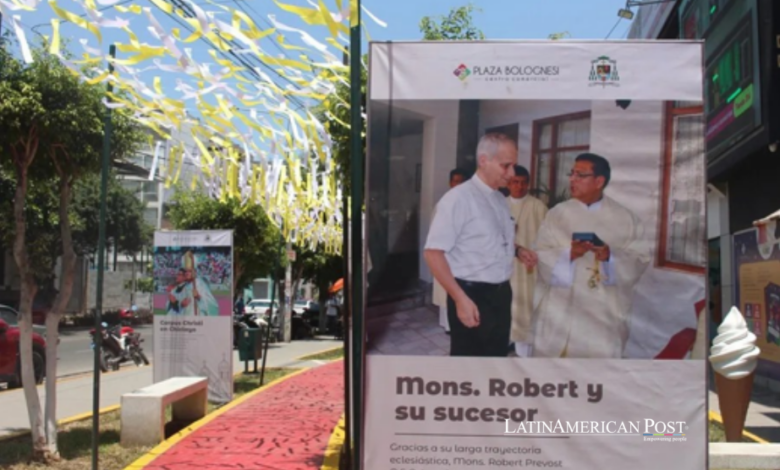
The narrative presented by the exhibition is not one of distant celebrity, but of intimate familiarity. The images trace a chronology that stretches from Prevost’s childhood in Chicago to his decades of service in Peru. One panel shows a young Prevost meeting Pope John Paul II in 1982, while others depict his later years in Chiclayo. Here, the visual record captures moments of direct human contact: a young bishop serving portions of Peruvian stew at a community kitchen, or arriving on horseback in an Andean village surrounded by children. These scenes illustrate a style of ministry that prioritized presence over protocol. As Augustine Sotelo, manager of the shopping center, told EFE, “He has left his mark.” His assessment points to a bishop whose responsibilities regularly brought him into contact with people beyond the cathedral walls, engaging in social work and participating in public and religious projects, including his involvement with Santo Toribio de Mogrovejo University.
The depth of this connection is rooted in specific historical events that tested the resilience of the region. The exhibition includes stark imagery from the 2017 coastal El Niño emergency, a period when heavy rains in northern Peru turned ordinary routes and homes into zones of danger. In one photograph, Prevost is seen in rubber boots, wading through floodwater. This visual detail is significant not merely as a symbol of a leader getting his feet wet, but as evidence of his engagement with a crisis that affected the entire Lambayeque region. Peru’s civil defense agency recorded that 182,955 people were affected or severely affected across the region’s 38 districts during that disaster. The geographical reach of the emergency meant that assistance had to move through an entire regional network while households, roads, and public buildings were under strain. In that context, a meal served through a communal kitchen was part of a larger economy of survival, where neighbors organized around needs that could not wait for institutional responses alone.
Prevost’s tenure in Chiclayo was substantial. He became the apostolic administrator in 2014 and the diocesan bishop in 2015, serving locally for roughly eight years before his elevation to a senior Vatican official position in 2023. During this period, he spent more than two decades in Peru and became a citizen in 2015. This long-term commitment allowed for the development of trust through repetition. The exhibition does not reduce local religious life to disaster relief; it equally features baptisms, confirmations, and village celebrations. These occasions matter because the relationships formed during times of joy and normalcy complicate the shorthand of an American pope with a Peruvian connection. For the residents of Chiclayo, the man who appeared at their family celebrations is the same man who returned during emergencies, creating a bond that official biographies often compress into a list of appointments.
The exhibition also highlights the commercial and cultural dimensions of this legacy. While a shopping center helped organize the tribute, and a papal visit could theoretically bring customers to local businesses, there are no attendance or spending figures to justify confident predictions of an economic windfall. The public affection is visible, but its conversion into broadly shared income remains a separate question. Chiclayo already serves as a gateway to the Moche heritage, associated with the Lord of Sipán and the royal tombs museum in nearby Lambayeque. This new exhibition adds a different kind of memory: one where people still living can recognize the occasions, institutions, and streets their former bishop moved through.
The significance of these images lies in their ability to preserve the texture of encounters that might otherwise be lost. A hand resting on an older woman’s forehead, or a bishop sharing a meal, conveys a sense of belonging that ranks and titles cannot capture. As the city waits for clarity on the pope’s health and travel plans, the exhibition offers a space for reflection. Sotelo noted that the exhibition would wait for him if the visit were postponed, emphasizing that the operative words in the local narrative are “among us.” For now, the photographs stand in for the expected visitor, allowing Chiclayo to revisit the meals, ceremonies, and difficult days without knowing exactly when he will return. In those images, Leo XIV is already back in Chiclayo, standing among people who knew him before the world learned his name.