This juxtaposition of diplomatic performance and strategic withdrawal offers a compact portrait of a relationship currently caught between its historical legacy and contemporary geopolitical pressures. The collapse of the MGCS is not an isolated incident but part of a broader pattern of divergence that extends to air power and economic policy. The demise of the Future Combat Air System (FCAS), Europe’s next-generation fighter jet project, has been a long time coming, but its announcement was blindsiding. German officials leaked the decision to the press ahead of the Berlin Air Show, ostensibly to open the way for alternative industrial alliances, taking French officials by surprise with a seeming *fait accompli*. French comments to the press subsequently blamed Berlin for the breakdown, ending years of pretense that political will could overcome industrial divorce.
The friction is not limited to defense hardware. In any given discussion with officials from either country regarding European defense, trade relations with China, energy security, or the relationship with the United States, finger-pointing and the drudging up of historical suspicions are common. These tensions are stark against the backdrop of an epochal upheaval in the international order. While Brussels has grown accustomed to navigating this stormy relationship, it relies on both powers pulling in the same direction to maintain Europe’s geopolitical standing. Other member states, such as Denmark, Estonia, Finland, and Poland, are stepping up their own capabilities, but the economic weight of Paris and Berlin remains central to any collective European strategy.
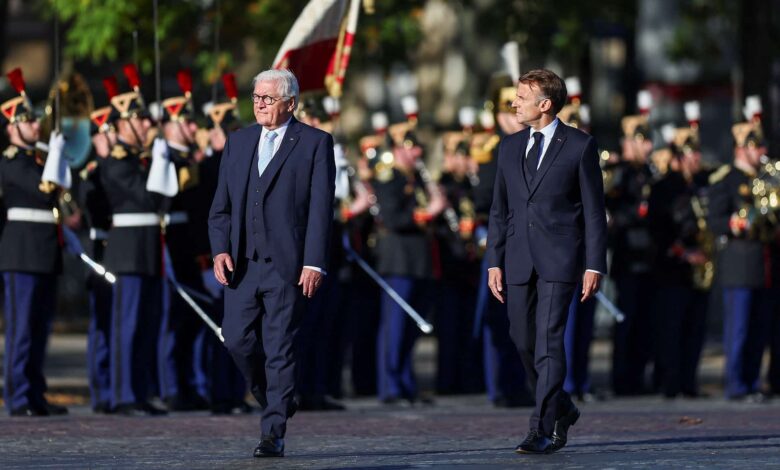
Despite these underlying currents, the current leadership has made concerted efforts to project harmony. Chancellor Friedrich Merz and President Macron held four meetings in a single week, including joint ministerial sessions and a visit to Augustusburg Palace in Brühl, western Germany. This venue is symbolic, as it was where President Charles de Gaulle and Chancellor Konrad Adenauer laid the foundation for the Franco-German partnership in 1962. Merz also participated in the parade on France’s National Day, July 14, in Paris—the first time a German chancellor has done so since Angela Merkel’s attendance in 2019. German government spokesperson Steffen Meyer dismissed speculation about a cooling of relations, stating, “There is absolutely no question of a cooling of relations; on the contrary, the relationship is very good, and we are continuing to work to ensure that it stays that way.”
However, experts suggest that this visible cooperation requires hard work to sustain. Stefan Seidendorf, deputy director of the German-French Institute in Ludwigsburg, noted that significant differences remain, particularly in energy policy—Germany’s phaseout of nuclear power versus France’s pro-nuclear stance—and in European fiscal policy. Nevertheless, cooperation is deepening in the area of nuclear deterrence. Driven by a growing sense in Berlin that U.S. nuclear protection is becoming unreliable, German troops are expected to participate in a French nuclear exercise this fall, a first in history. This development highlights a shift in security calculations that may force a closer alignment despite other disagreements.
The stakes for the alliance are further elevated by the upcoming French presidential election. With nine months remaining until the vote, the political landscape in Paris presents a direct threat to the current trajectory of Franco-German relations. Far-right leader Marine Le Pen, whose party was founded by her father Jean-Marie Le Pen alongside Nazi collaborators, is a strident euroskeptic. Her potential victory poses a well-recognized problem in Berlin. Similarly, far-left leader Jean-Luc Mélenchon, who has devoted an entire book to his disdain for the German economic model, has signaled he would seek to overturn the foundational partnership. Mélenchon stated that he would not commit to the recent series of agreements between Macron and Merz on issues ranging from nuclear deterrence to industrial policy, viewing the alliance as primarily serving Berlin’s interests.

“Mélenchon’s political positions on key issues of European policy, his hostility toward Germany … would make him a massive problem for Franco-German cooperation,” said Roland Theis, a German lawmaker from Merz’s conservative party. While recent surveys suggest Le Pen would handily defeat Mélenchon in a runoff, the disruptive potential of both candidates is acknowledged in the halls of power across the Rhine. The fear in Berlin is that a change in Paris could unravel the delicate balance that has allowed the two nations to manage their differences while projecting strength.
As the diplomatic calendar moves forward, the focus shifts from the symbolic gestures of state visits to the practical realities of industrial and political alignment. The next critical juncture will be the French presidential vote, which will determine whether the current framework of cooperation, however strained, can survive the next political cycle. Until then, the partnership remains a work in progress, defined as much by its recent fractures as by its enduring institutional inertia.