
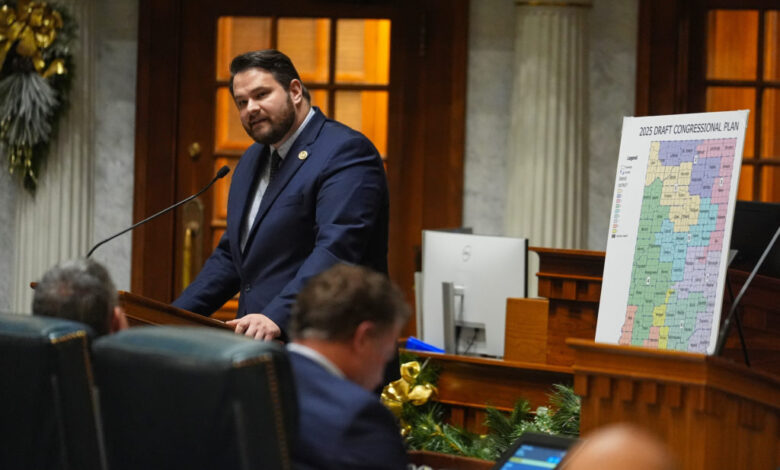
The outcome was characterized as an upset by observers who had not predicted the Republican incumbent’s loss in such a deeply conservative area. Ford’s win illustrates a broader trend in this election cycle, where the Democratic Party has demonstrated an ability to break through not just in traditional battleground districts, but in several deep red districts as well. This development suggests a changing dynamic in congressional elections, where the usual alignment between presidential performance and House races may be eroding in specific geographic contexts.
Both candidates bring distinct historical significance to the office. Ford is the first openly gay member of the Indiana General Assembly, while Spartz is the first and only Ukrainian-born member of Congress. Their respective backgrounds have defined much of the district’s political identity, with Spartz serving as a prominent voice for her constituents during her three terms in the U.S. House.
The political implications of Ford’s victory extend beyond the individual race. In a separate statement referenced in coverage of the midterms, President Trump acknowledged that Democrats “did a good job,” while attributing losses to individual Republican candidates rather than the party or his leadership. This reaction underscores the complexity of the electoral results, where national leadership is credited with success despite localized defeats in key districts.
The District 5 race was part of a larger national contest that tested the resilience of both parties. For the Democrats, the pickup in Indiana’s 5th represents a strategic breakthrough in a state that has historically leaned heavily Republican in congressional races. The fact that Ford won in a district that voted overwhelmingly for Trump two years ago indicates that local candidates can override national partisan dynamics under certain conditions. Conversely, the loss poses a challenge for the Republican establishment, which must now assess how to defend similar seats in future cycles.
Institutional context is crucial to understanding the stakes of this race. Congressional districts are fixed geographic units that determine representation in the House, and shifts in these seats alter the balance of power in the chamber. A single seat flip, while minor in numerical terms compared to the 435 total House seats, carries significant symbolic weight, particularly when it occurs in a district perceived as safe for the opposing party. Ford’s victory contributes to the Democratic tally, potentially affecting committee assignments and legislative leverage in the new Congress.
Analysts note that the “upset” nature of the result reflects a disconnect between pre-election polling or predictions and the actual voting behavior in the district. While the sources do not provide specific polling numbers or detailed campaign strategies for this particular race, the consensus among the reporting outlets is that the outcome was not widely anticipated. This suggests that underlying voter sentiment in the district may have shifted in a way that was not fully captured by traditional metrics.
The defeat of Spartz also highlights the diversity of representation in Congress. As the first Ukrainian-born member of Congress, Spartz’s departure marks the end of a unique chapter in congressional history. Ford’s entry, as the first openly gay member of the Indiana General Assembly to win a federal seat, adds another layer of diversity to the composition of the House. These demographic shifts are often cited by political scientists as indicators of broader social changes that may influence future electoral dynamics.
As the new Congress prepares to convene, the focus will turn to how these individual results aggregate into a functional legislative majority. The ability of Democrats to win in deep red districts like Indiana’s 5th may embolden the party to target similar seats in other states, while Republicans may seek to regroup and analyze the factors that led to the incumbent’s defeat. The next phase of political development will involve the organization of the new House leadership and the setting of the legislative agenda, with the composition of the chamber determined by results like Ford’s upset.
For now, the immediate consequence is the transfer of power in District 5. Ford takes the oath of office as the new representative, bringing his state-level experience and distinct political identity to the federal stage. Spartz’s career in the U.S. House concludes after three terms, leaving her constituents to be represented by a Democrat in a district that has long been a Republican stronghold. The result stands as a testament to the volatility of the current political environment, where established predictions on the ground may no longer hold true.