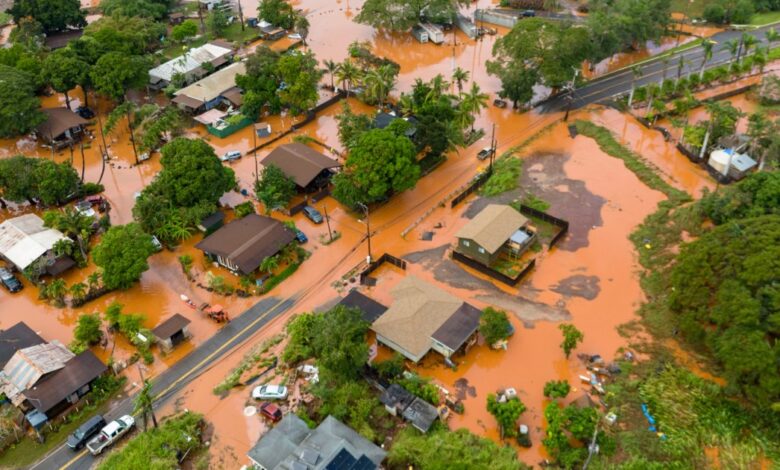
By Saturday, the scale of the disaster had become apparent. Floodwaters had lifted homes and cars, and authorities issued evacuation orders for 5,500 residents located north of Honolulu. Governor Josh Green stated that the cost of the storm could exceed $1 billion, citing extensive damage to airports, schools, roads, private residences, and a hospital in Kula on Maui. “This is going to have a very serious consequence for us as a state,” Green said at a news conference, emphasizing the ongoing threat as more rain was expected over the weekend.
The storm system, classified as a Kona low, drenched areas already weakened by previous downpours. The National Weather Service issued flash flood warnings early Saturday, noting that light to moderate showers were turning heavy in specific locations. Radar data indicated heavy showers and thunderstorms redeveloping over West Maui, with rainfall rates reaching 1 to 2 inches per hour. These measurements signaled that flooding remained ongoing and that dangerous conditions persisted well into the evening.
“Residents in the Waialua area are strongly urged to LEAVE NOW. The remaining access road out of Waialua is at high risk of failure if rainfall continues.”
This emergency alert, sent on Saturday morning, underscored the imminent danger facing isolated communities. Sirens were eventually activated to warn residents to flee. In the Waialua area, resident Sienna Creasy woke to screams from neighbors hours before official alarms sounded. She moved to higher ground, where she described having a “bird’s eye view of the chaos.” From there, she heard a neighbor calling for help as his house floated toward another building. Creasy tracked down the address and posted it to every available message board, an act that highlighted the critical, albeit fragile, communication networks functioning amidst the infrastructure collapse.
While evacuation orders for some Oahu residents were lifted as the storm system began to move east, the threat remained severe. The Oahu Department of Emergency Management confirmed that while immediate danger had passed for some, the risk of flash floods persisted from Oahu to the Big Island through Sunday afternoon. Flash flood watches remained in effect for Oahu, Maui, Molokai, Lanai, Kahoolawe, and the Big Island. Specific warnings indicated that parts of the Big Island remained under flash flood warnings through noon Sunday local time, while Maui faced dangerous flooding through 9 p.m. local time.

The environmental and economic impact extends beyond immediate displacement. The saturation of the soil following back-to-back storm systems increases the likelihood of landslides and dam failures, particularly for older infrastructure like the 120-year-old dam cited by authorities. The $1 billion estimate reflects not just physical destruction but the strain on state resources and the disruption of essential services, including healthcare and transportation. As the storm moves east, the focus shifts to the Big Island and Maui, where communities are bracing for continued heavy rains and the potential for further flooding.
The situation illustrates the compounding risks faced by island environments during extreme weather events. When soil saturation reaches a critical point, even moderate rainfall can trigger catastrophic flooding. For Hawaii, the challenge is not only managing the immediate aftermath of this storm but also preparing for the next system, as Governor Green noted: “Hawaiʻi — we are still in this.” The next verified development will be the assessment of the dam’s stability and the extent of infrastructure damage across the state as the weather system dissipates.