
Breaking the “Firewall”
Rausch won the secret ballot with 48 votes, defeating opposition candidates who received 29 votes, with five abstentions. The AfD holds 39 of the 83 seats in the parliament, falling three seats short of an absolute majority. However, the election was secured by the support of five members from the BSW (Bündnis Sahra Wagenknecht), a smaller left-wing party. This cross-aisle support represents a significant breach of the “firewall”—an unwritten but firmly held consensus among traditional German parties to refuse cooperation with the AfD.
Christian Leye, deputy leader of the BSW, defended the party’s decision, arguing that the traditional isolation strategy was no longer effective. “The firewall is not working,” Leye stated. “We need a smarter way of dealing with the AfD and that means tackling the content of their programme instead of a firewall.” This willingness to engage with the AfD suggests that the party may now be positioned to form a state government, a feat that would constitute another historic first in German politics.
Political Significance and Reaction
The AfD, which the Office for the Protection of the Constitution has classified as right-wing extremist, has long been a dominant force in the former communist East. In his acceptance speech, Rausch promised to represent all voices, stating, “I will not serve in this office as the speaker of a single parliamentary group, but as the speaker of all parliamentary groups. Rules must apply even when the majority changes.” However, his gesture of inclusivity was met with silence from opposition lawmakers, who did not applaud.
Chancellor Friedrich Merz reacted sharply to the developments, labeling the rise of the AfD as a threat of “extremism” to German society. Speaking in Berlin, Merz stated that voting for the AfD was “undermining credibility” and “incompatible with the values” of the Christian Democratic Union (CDU). The Chancellor’s comments highlight the tension within the governing coalition as support for mainstream parties erodes in the face of a fragmented political field.
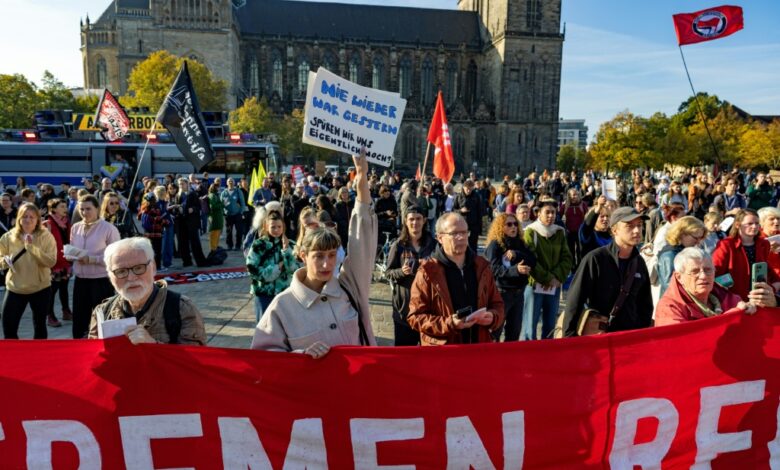
Outside the parliament building in Magdeburg, the political divide was visible. Approximately 500 protesters gathered on Cathedral Square, holding banners with slogans such as “Never again is now” and “No cooperation with the far right.” Sandy Gaertner, an organizer of the demonstration, accused the AfD of “hollowing out, stretching and even trampling on” the constitution. Eva von Angern, the senior-most member of the parliament and a member of the Left Party, opened the session by quoting the Basic Law on human dignity, a passage that received no reaction from the AfD caucus.
Internal Dynamics and Future Prospects
The internal dynamics of the new parliament reflect the AfD’s growing confidence. In a deliberate display of power, the AfD caucus, composed predominantly of men, arranged to sit in the center of the plenary chamber, positioning themselves directly in front of the lectern. This seating arrangement, pushed through in preliminary talks, places the “old parties”—the CDU, SPD, Left, and Greens—on the periphery, visually reinforcing the AfD’s claim to be the central political force in the state.
Later in the day, Hans-Thomas Tillschneider, associated with the AfD’s more extreme wing and a scholar of Islamic studies, was elected as Rausch’s deputy with 44 votes. Tillschneider, who has praised Russian President Vladimir Putin and described Islam as a “fungus” growing on the “German oak,” is expected to become the state’s culture and science minister. His election further complicates the political landscape, as the BSW had previously stated it would not support him, suggesting that additional, undisclosed voting blocs may be aligning with the AfD’s agenda.
The next critical step in this political process is the formation of a state government. With the support of the BSW and potentially other cross-party votes, the AfD is now in a position to negotiate a coalition that could bring it into executive power for the first time in Germany’s history. This development poses a significant challenge to the federal government and the established political order, forcing a re-evaluation of how mainstream parties interact with the far right in a deeply polarized electorate.