While the AfD’s rise has alarmed German centrist parties, it is also creating unexpected tensions among its ideological counterparts across Europe. Major far-right parties in France, Italy, and Britain have remained largely silent following the AfD’s recent electoral successes, a notable contrast to the congratulations offered by leaders such as Hungary’s Viktor Orbán, Spain’s Santiago Abascal, and the Netherlands’ Geert Wilders. France’s National Rally (RN), once a close partner to the AfD in the European Parliament, has explicitly distanced itself. RN lawmaker Franck Allisio stated on September 6 that the party does not consider the AfD an ally, citing fundamental differences in style and substance.
This diplomatic cooling is driven by the RN’s strategic “detoxification” campaign, which seeks to rebrand the party toward the political mainstream ahead of the 2027 presidential election. Party leader Marine Le Pen has worked to soften anti-immigration rhetoric and distance the brand from the Nazi past of two of its founders. The RN formally severed ties with the AfD in May 2024, a decision prompted by comments from senior AfD figures downplaying the role of the SS in World War II and the emergence of a secret plan to expel people of foreign origin en masse. Grégoire Roos, a director at the Chatham House think tank, noted that unlike the RN, the AfD has made no effort to purge extremist factions, maintaining a posture that remains unpalatable to many European peers.
Domestically, the AfD continues to test the boundaries of Germany’s “political firewall,” a policy adopted by centrist parties to prevent cooperation with groups classified as extremist. The Christian Democratic Union (CDU), led by Chancellor Friedrich Merz, formally rejected coalitions with the AfD in 2018. However, this stance faced a significant breach in January 2025 when a CDU motion to reject asylum seekers passed in the Bundestag with AfD support. Although Merz was then the opposition leader, critics argue the move undermined the firewall. The center-left Social Democratic Party (SPD) and the Greens maintain a comparable refusal to cooperate with the AfD, though without formal resolutions. In contrast, Sahra Wagenknecht, founder of the left-wing Alliance Sahra Wagenknecht (BSW), has explicitly opposed excluding the AfD, suggesting she would support an AfD-led government in Saxony-Anhalt.
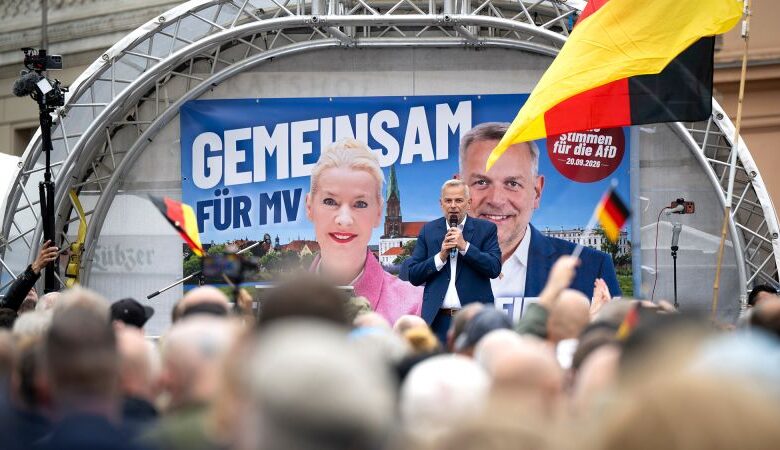
The political standoff has sparked widespread civil unrest. On Saturday, approximately 150,000 demonstrators marched in roughly 20 cities, including Berlin, Hamburg, and Munich, to protest the AfD’s gains. Organized by the campaign group Pruef, the rallies featured signs demanding an immediate ban on the party, with slogans such as “Democracy needs no alternatives.” The AfD held a separate counter-rally in Berlin, attended by its lead candidate for the upcoming regional election, Kristin Brinker. While the Federal Office for the Protection of the Constitution has classified certain AfD state associations as “confirmed right-wing extremist,” the party as a whole has not been banned, a determination that would require a formal application to the Federal Constitutional Court. No such application has been filed to date.