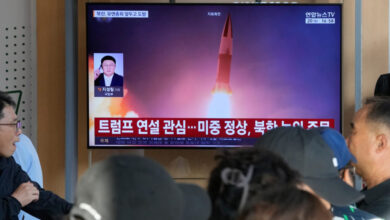
The launch marks the fourth ballistic missile test conducted by Pyongyang this month. South Korea’s Joint Chiefs of Staff (JCS) stated that the missiles were fired from the Pyongyang area and characterized the event as a “show of force.” This assessment follows South Korea’s own recent military demonstration: on Thursday, Seoul conducted its first test launch of a hypersonic glide vehicle (HGV), a maneuver widely interpreted as a direct response to heightened tensions on the Korean Peninsula.
The escalation in missile activity occurs against a backdrop of severe diplomatic and military strain between the two Koreas. The immediate trigger for the current surge in activity appears to be a series of incidents, most notably a mine explosion on September 21 in the Demilitarized Zone (DMZ) on the South Korean side. The blast injured three South Korean soldiers, two of whom remain in critical condition. A recent joint investigation by the South Korean JCS and the United Nations Command concluded that the explosion was caused by landmines intentionally laid by North Korean forces.
Pyongyang has categorically denied responsibility for the incident, accusing Seoul of falsifying the investigation results. North Korean state media issued warnings of “immediate and merciless” retaliation if South Korea implements countermeasures. Prior to Monday’s launches, North Korea had already conducted a missile test on October 3 from the Wonsan area. The following day, state media claimed the launch involved a medium-range strategic missile equipped with “hypersonic strategic weapons,” a designation that aligns with the type of technology South Korea recently tested.
Military observers note that the timing of these launches suggests a deliberate signaling strategy. By firing missiles in close succession to South Korea’s hypersonic test, Pyongyang is likely seeking to reaffirm its nuclear and missile capabilities while challenging South Korea’s emerging high-speed strike assets. The logistical details of the launches—specifically the variation in range and altitude—indicate a test of different missile variants or flight profiles, though specific weapon designations remain unconfirmed by independent analysts.
In response to the launches, South Korean military forces have heightened their surveillance posture and are maintaining a state of full combat readiness. The JCS confirmed that it is exchanging real-time information with the United States and Japan to coordinate regional defense responses. The involvement of Tokyo is particularly significant given that the missiles landed in waters approaching Japan’s maritime boundaries, underscoring the trilateral security dynamics now central to peninsula defense.
The recent sequence of events highlights a narrowing window for diplomatic engagement. With both sides conducting advanced missile tests and engaging in reciprocal accusations of aggression, the risk of miscalculation in the region has increased. The confirmed placement of mines in the DMZ and the subsequent missile salvos demonstrate that North Korea is willing to escalate military posturing to pressure its neighbors and allies. As South Korea continues to integrate hypersonic glide vehicles into its arsenal, Pyongyang’s rapid-fire testing cadence suggests an intent to maintain a credible deterrent against potential precision strikes.
For now, the focus remains on monitoring further launches and assessing the impact of these tests on regional stability. The next confirmed development will likely depend on whether South Korea or the United States responds to the missile launches with additional military exercises or diplomatic condemnations, further defining the contours of security on the Korean Peninsula.