
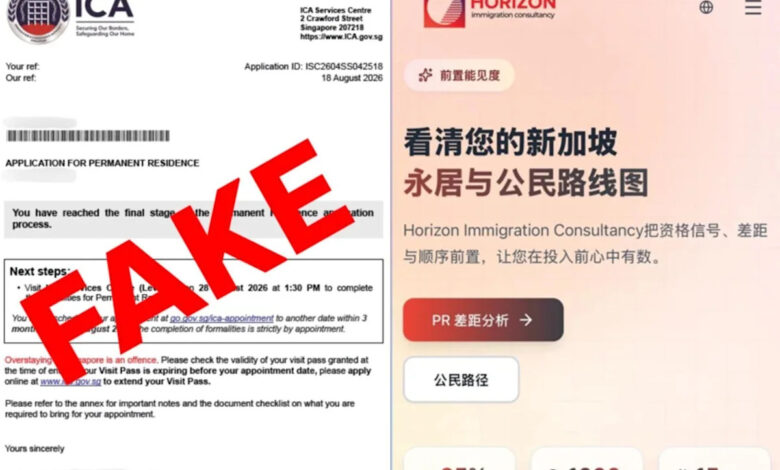
In the first category, which accounts for the majority of reported incidents, victims received calls from individuals claiming to be ICA officers. These callers asserted that the victims’ personal details had been misused or that their phone numbers were linked to criminal activities, such as the transmission of scam messages. The calls were subsequently transferred to a second caller impersonating a Chinese official, who demanded the transfer of funds for “investigation” or “bail” purposes. In some instances, victims were instructed to meet unknown individuals to sign fabricated documents. Authorities reported 117 cases under this scheme, with losses totaling at least $8.4 million. Most victims identified the fraud only after multiple transfers had been made or when the scammers became unreachable.
The second category involves fake advertisements posted on social media platforms, including Facebook, offering assistance with Singapore PR applications. Clicking on these ads directs users to websites of fictitious consultancy agencies where they are prompted to submit personal particulars, including mobile numbers. The fraudsters then contact victims via WhatsApp, requesting “fees” ranging from $200 to $90,000 to proceed with the application. These payments are justified under the pretext of improving success rates through investments in companies, purchases of academic certifications, or donations. Victims are instructed to make bank transfers or pay cash to unknown individuals. Following payment, they receive a fake automated acknowledgment email purportedly from the ICA, which includes an attachment of a fake In-Principle Approval (IPA) letter bearing the ICA letterhead. Authorities recorded at least 31 reports related to this specific scheme, with losses of at least $400,000. Victims often discovered the deception only after attempting to verify the authenticity of the IPA letters directly with the ICA.
These fraud operations occur against a backdrop of heightened border security and operational changes at Singapore’s key entry points. On September 24, ICA officers detected more than 391 kilograms of cannabis concealed within boxes of gloves in an inbound container at the Pasir Panjang Scanning Station. The drugs were identified as transiting through Singapore and bound for another country. Under Section 7 of the Misuse of Drugs Act 1973, individuals who import or export more than 500 grams of cannabis face the mandatory death penalty. The Central Narcotics Bureau is continuing its investigation into the network behind this seizure.
Separately, ICA operations at the Woodlands Checkpoint have focused on preventing the smuggling of contraband. On September 26, officers sliced open the tyres of a Malaysia-registered vehicle during enhanced checks and discovered over 980 packets of duty-unpaid cigarettes hidden inside. The 31-year-old Malaysian driver was arrested, and the case has been referred to Singapore Customs. Under the Customs Act and the Goods and Services Tax Act, offenders face fines of up to 40 times the amount of duty and GST evaded, imprisonment of up to six years, or both. Vehicles used in such offences may also be forfeited.
In a move to streamline traffic flow, the ICA announced that selected car lanes at the Woodlands Checkpoint will open to motorcyclists and pillion riders for automated departure clearance starting October 15. This option is available to all Singapore residents, long-term pass holders, and foreign visitors who have previously entered the country. Utilizing facial recognition technology, these lanes are expected to reduce clearance times by approximately 10%, or around two seconds per motorcycle, compared to manual processing lanes. Users are required to lift helmet visors and remove sunglasses or face masks to allow for facial verification before exiting the lane.
The ICA and police have urged the public to remain vigilant and verify the authenticity of any official communications or documents directly through authorized ICA channels. Investigations into the organized networks behind the $8.8 million in scam losses and the drug smuggling operations are ongoing.