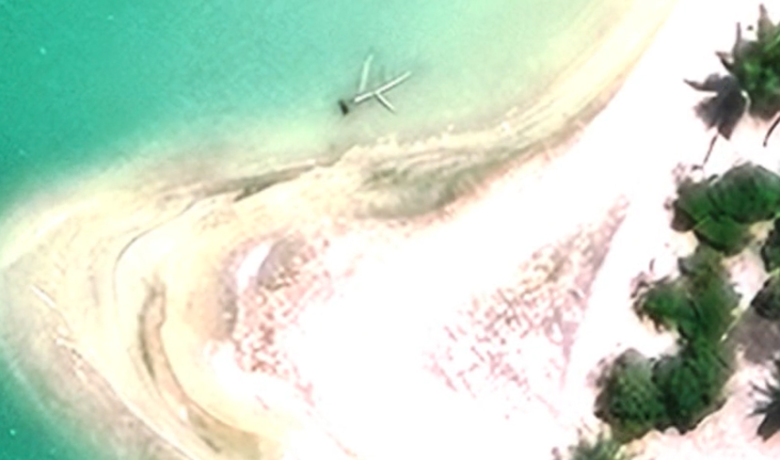
The aircraft, known as the “Taraia Object,” was first identified in satellite imagery in 2020. Subsequent analysis confirmed that the object has been visible in aerial photography of the area dating back to 1938, shortly after Earhart’s disappearance. The official historical record states that Earhart and her navigator, Fred Noonan, vanished while attempting to reach Howland Island to refuel. While the prevailing theory holds that the plane crashed into the ocean due to fuel exhaustion and communication failures, no physical evidence of the aircraft has ever been recovered, leaving the exact cause of the loss unverified.
The expedition represents a significant logistical undertaking, involving a six-day sea voyage aboard the Kiribati National Shipping Line vessel Marin Mainiku. The team departed Tarawa, the capital of Kiribati, to navigate an 830-mile journey to the remote atoll. Upon arrival, researchers will need to pass through a narrow gap in the atoll’s reef, a channel created by British forces in 1963, which marks the last time the island was inhabited. The team is scheduled to spend several days on-site conducting the inspection.
The mission follows a period of administrative and environmental delays. Originally announced in July 2025, the expedition was postponed in October 2025 to complete permit approval processes with the Republic of Kiribati. Additionally, the onset of the South Pacific cyclone season during the winter months prevented a safe departure later that year. The current mission includes three representatives from Purdue University: Steve Schultz, Senior Vice President and General Counsel, and alumni Sirisha Bandla and Marc Hagle, both associated with Purdue’s Cradle of Astronauts program.
Richard Pettigrew, executive director of ALI and the expedition lead, emphasized the focus on the execution of the fieldwork plan. “With just a week to go before the launch of our expedition, my conscious focus is on the execution of our fieldwork plan,” Pettigrew stated. “Inevitably, though, this comes with an array of strong feelings. I’m intensely and eternally grateful to the many individuals and organizations who have helped to make our vision real. I feel truly lucky to be in a position to possibly solve one of the greatest mysteries of all time, whether or not that happens.”
Earhart had already successfully flown from California across South America, Africa, and Asia when she arrived in Lae, Papua New Guinea, on July 2, 1937. Her final leg was intended to cross the Pacific to Hawaii and then back to California. The disappearance has spawned decades of speculation, ranging from simple fuel exhaustion to theories of interference. While the ocean crash narrative is largely accepted, the absence of physical debris has kept the case open to alternative interpretations. This expedition seeks to provide the first tangible evidence to corroborate or refute the existing historical account.
Identifying the Taraia Object as the Electra would require definitive physical confirmation, such as matching serial numbers, distinct structural components, or other unique identifiers of the specific aircraft. The team’s findings will be evaluated to determine if the anomaly is indeed the lost plane or an unrelated natural formation or debris. The results of this inspection may provide the first concrete physical evidence regarding the fate of Earhart and Noonan, offering a new direction for historical and archaeological understanding of the event.