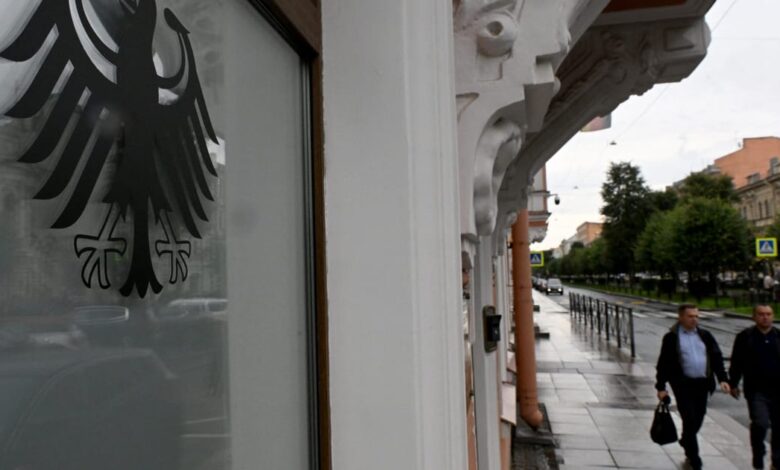
The closure is a direct retaliation for recent measures taken by the German government. Last week, Berlin announced that it held Russia responsible for a drone attack on its own soil. The incident involved three drones carrying explosive material detected at or near the Leipzig-Halle Airport. One of these drones was found in the vicinity of a Ukrainian Antonov aircraft being used to transport munitions. Following this finding, German Foreign Minister Johann Wadephul unveiled a package of countermeasures. These included the closure of Russia’s consulate in Bonn and the Russian House cultural institution in Berlin, also effective September 18. Furthermore, Germany has expelled 150 Russian diplomats along with their families.
Moscow’s response has been symmetrical in scope but expansive in cultural reach. In addition to the St. Petersburg consulate, Russia announced it would close branches of the Goethe-Institut, the German cultural center, in Moscow, Saint Petersburg, and Novosibirsk. The Russian foreign ministry stated explicitly that it was the German authorities who “provoked a new round of escalation in bilateral relations,” assigning all responsibility for the consequences to the Government of Germany. The statement framed the closure not as an isolated incident, but as a necessary consequence of Berlin’s actions.
This diplomatic tit-for-tat occurs against a backdrop of increasing security concerns across Europe. In recent months, EU nations have reported a growing number of suspected Russian attacks targeting military sites and critical infrastructure. In August, two drones were spotted over a Bundeswehr site in Germany. Closer to home, Poland is investigating the deliberate arson of a drone factory near Warsaw, viewing it as potential foreign sabotage. These events have heightened the perception of hybrid warfare, where the line between state-sponsored sabotage and diplomatic sanction is increasingly blurred.
German officials have signaled that the current escalation is not the peak of the threat. Interior Minister Alexander Dorbindt warned that Germany has yet to witness the full extent of potential attacks. “We assume that Germany is the target of further hybrid attacks by Russia,” Dorbindt stated, adding that it can also be assumed there is a willingness to cause even greater damage through such means. This assessment suggests that the closure of diplomatic posts is part of a broader security environment where economic and cultural ties are being sacrificed for perceived national security imperatives.
The removal of the 150 Russian diplomats and their families represents a significant logistical and symbolic shift. While the Russian embassy and consular services in Moscow remain open, the loss of the St. Petersburg consulate reduces Germany’s capacity to conduct consular work and maintain low-level diplomatic contact in one of Russia’s most important economic centers. Similarly, the closure of the Goethe-Institut branches in Moscow, Saint Petersburg, and Novosibirsk severs key cultural and educational links that have persisted since the end of the Cold War. For the individuals involved—diplomats, cultural staff, and their families—the immediate effect is displacement. They must leave their posts, potentially severing personal and professional networks built over years of service.
The economic implications, while secondary to the security crisis, are non-trivial. The closure of consulates and cultural institutes reduces the institutional framework for business and civic exchange between the two countries. In a period where trade volumes are already constrained by sanctions and counter-sanctions, the removal of these diplomatic and cultural anchors further isolates the two economies. The Goethe-Institut, for instance, has long served as a point of contact for German businesses and students seeking to engage with Russian markets. Its closure in three major cities eliminates a neutral ground for such interactions, potentially complicating any future diplomatic or economic dialogue.
The dispute over the Leipzig drones is central to this escalation. Germany’s attribution of the attack to Russia, based on the presence of explosive material and the proximity to a military-related aircraft, has triggered a proportional response in terms of diplomatic personnel. The synchronization of dates—September 18 for both the German and Russian closures—underscores the calculated nature of this exchange. It is a clear message of reciprocity: for every action taken by Berlin, Moscow will take a corresponding action.
Uncertainties remain regarding the long-term trajectory of these relations. While the immediate steps are irreversible in the short term, the broader diplomatic framework may still be salvageable if security incidents do not escalate further. However, the rhetoric from both sides suggests a hardening of positions. The Russian foreign ministry’s insistence that Germany bears “entirely” the responsibility for the consequences leaves little room for compromise or de-escalation in the near future.
The next pivotal moment will be September 18, when the orders are enforced. The departure of German staff from St. Petersburg and the withdrawal of Russian diplomats from Germany will mark a tangible reduction in the footprint of both nations in each other’s territories. For the workers and families affected, this is a sudden and disruptive change in their professional lives. For the broader economy, it is a signal that the costs of geopolitical conflict are now being paid in the form of institutional disconnection. As the drones continue to be a point of contention, the diplomatic and cultural bridges that once connected Berlin and Moscow are being systematically dismantled, one closure at a time.