
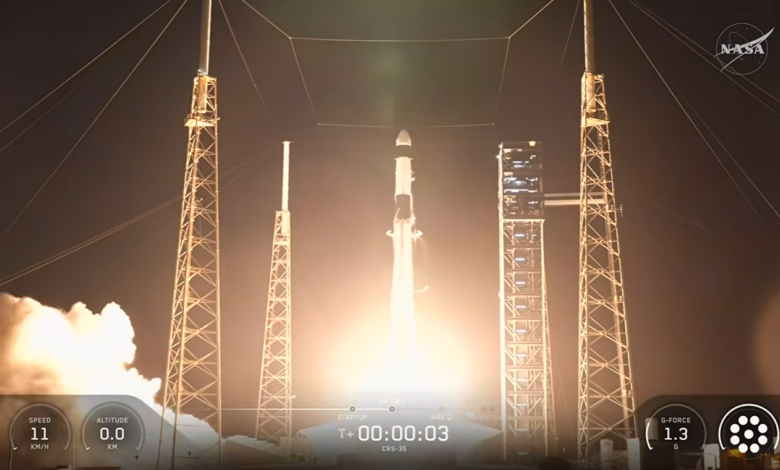
The primary objective of the mission, designated CRS-35, is to augment the power generation capabilities of the aging International Space Station (ISS). Stowed in the unpressurized trunk of the SpaceX Dragon spacecraft, tail number C211, is the final pair of International Space Station Roll-Out Solar Arrays (iROSAs). These arrays are the last component needed to complete the station’s power system augmentation. By boosting available electricity, the arrays will support increased research, operations, and the station’s eventual safe, controlled deorbit. Astronauts are scheduled to install these arrays during a series of spacewalks planned for later this fall.
Beyond the solar infrastructure, the Dragon spacecraft is carrying more than 6,300 pounds of supplies and hardware, including new scientific experiments designed to leverage the microgravity environment. The cargo includes hardware to manufacture artificial retinas in microgravity, a process that could potentially help restore vision for patients on Earth. Additionally, the mission transports 3D heart tissue models intended to advance large-scale drug testing for future space missions, as well as materials to study the formation of a new type of glass using non-traditional elements. Another key payload consists of brain organoids, which researchers hope will uncover potential treatment targets for neurodegenerative diseases such as Alzheimer’s, Parkinson’s, and multiple sclerosis.
The Dragon spacecraft is also delivering critical maintenance and operational equipment. Among these items is a clamshell apparatus designed to house the failed Canadarm2 joint, which was removed from the station during a spacewalk on June 30. Bill Spetch, deputy manager of Commercial for NASA’s Low Earth Orbit Program, noted that the cargo also includes a dose pump for the station’s toilet, pre-treat quality sensors, and a robot microcontical tool used for maintenance and utilization tasks. “We also have a wealth of science experiments on board,” Spetch said, highlighting the studies on artificial retinas, heart tissue, glass formation, and inflammation linked to neurodegenerative diseases.
This mission utilizes the Falcon 9 first stage booster B1096, which is on its eighth launch after previously flying missions for NASA’s IMAP, CRS-34, NROL-77, NROL-95, GPS-III 9, Kuiper Falcon 01, and Starlink 6-87. The Dragon spacecraft itself, C211, is on its fourth flight, having previously completed cargo runs for CRS-26, CRS-29, and CRS-33. The space-facing docking port on the Harmony module, which the Dragon is scheduled to autonomously dock with at 11 a.m. EDT on Thursday, Oct. 15, was recently vacated by the Crew Dragon Freedom. That spacecraft safely delivered the four members of NASA’s SpaceX Crew-12 mission back to Earth with a splashdown on Oct. 8.
NASA will stream coverage of the rendezvous and docking procedures beginning at 9:15 a.m. EDT. The Dragon is scheduled to remain docked to the ISS until mid-November. At that time, it will depart the station to return to Earth, splashing down off the coast of California with time-critical research and cargo. These investigations, conducted in areas of biology, biotechnology, physical sciences, and Earth and space science, benefit people on Earth and lay the groundwork for deep space missions under NASA’s Artemis program, which aims to send astronauts to the Moon to prepare for future human exploration of Mars.