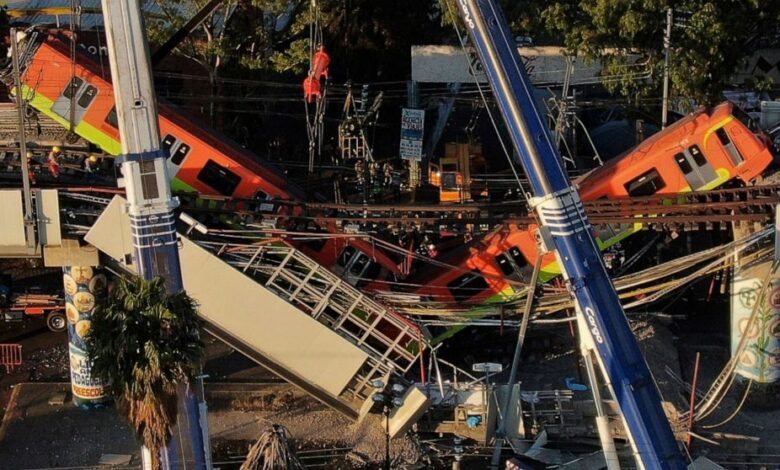
According to Mexico City Mayor Claudia Sheinbaum, a support beam or girder “gave way” just as a train passed over it near the Olivos station. Footage from the scene depicted a crane stabilizing one subway car left hanging from the collapsed section, while vehicles on the road approximately 16 feet below were buried under rubble. By early Tuesday morning, emergency crews confirmed that no further bodies remained at the scene as they began clearing the wreckage. Authorities reported that at least 49 of the 65 injured individuals were transported to hospitals, with seven in serious condition undergoing surgery. Sheinbaum noted that children were among the deceased, though specific numbers were not disclosed.
The immediate legal response has been the opening of a formal investigation by the Mexico City Attorney General’s Office (Procuraduría General de Justicia de la Ciudad de México). In a press conference, President Andrés Manuel López Obrador stated that “nothing would be hidden” from the public regarding the causes of the collapse. He emphasized that while condolences were offered to victims’ families, the identification of those responsible remained a priority. An external company has been contracted to investigate the technical causes of the failure, and the remainder of Line 12 is scheduled for a comprehensive structural survey. Until these inspections are complete, the line, which serves 20 stations, remains closed, with hundreds of buses deployed to cover the service gap.
The legal and administrative scrutiny of the incident is complicated by the line’s troubled history. Line 12, inaugurated less than a decade ago, has been plagued by structural issues, technical faults, and allegations of corruption since its opening. Marcelo Ebrard, the Secretary of Foreign Relations and former mayor who oversaw the line’s construction, described the event as a “terrible tragedy.” Ebrard stated on social media that “the causes should be investigated and those responsible should be identified,” offering his full cooperation to the authorities. His remarks highlight the potential for accountability to extend beyond immediate operational errors to broader institutional and contractual liabilities.
Reports indicate that residents had previously documented cracks in the structure following a deadly earthquake in 2017. According to local media, including El Universal, transport authorities conducted repairs after these reports. A third audit, referenced in recent reporting, suggests that a lack of maintenance may have contributed to the accident. These findings raise significant questions regarding compliance with safety regulations and the adequacy of oversight by the municipal transport authority. Under Mexican public liability law, the government may face civil claims for damages, while criminal charges could be pursued if negligence or corruption in the maintenance or construction contracts is proven.
Witness accounts provide context for the sudden nature of the collapse. One passenger, who identified herself only as Mariana, 26, told El Universal that she and others trapped in the twisted metal of the carriage managed to escape through a window. “We only heard a loud thunder, and everything fell apart,” she said. Another eyewitness described the structure shaking before the dust cloud obscured the scene. Families of missing passengers, such as Gisela Rioja Castro, reported having no information regarding the status of their relatives, underscoring the chaotic early hours of the emergency response.
The distinction between the current investigation and any future legal determinations is critical. At this stage, no individuals have been charged, and no findings of criminal guilt have been made. The presumption of innocence applies to all parties, including contractors, engineers, and municipal officials. The Attorney General’s Office will determine whether the evidence supports charges of negligent homicide, corruption, or other offenses. Simultaneously, the structural survey will establish the physical causes of the failure, which will inform both civil liability claims and potential regulatory reforms.
The next formal step involves the completion of the structural survey of the remaining Line 12 infrastructure and the release of the initial findings from the external technical investigation. These reports will likely be submitted to the judicial authorities to guide the scope of the criminal investigation. As the metro system remains closed, the focus shifts from emergency rescue to forensic analysis and legal accountability, with the public demanding transparency in identifying whether the collapse was the result of a singular mechanical failure or a systemic breakdown in maintenance and oversight.