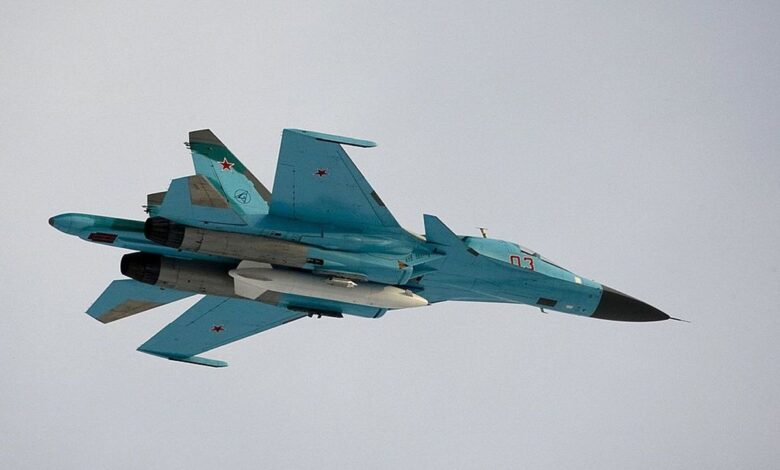
The Navy did not provide visual confirmation of the strike, and the Kyiv Independent was unable to independently verify the claim. However, President Volodymyr Zelensky later confirmed the destruction of the two Su-34 jets on the same day. He added that Ukrainian forces also targeted a Russian Iskander missile launcher during the operation. The Su-34 is a primary aircraft used by Russia to launch guided aerial bombs against Ukrainian cities, frontline settlements, and military positions. Ukrainian military intelligence (HUR) noted that such losses weaken Russia’s capacity for sustained aerial attacks, as replacing these aircraft requires significant time and resources.
According to HUR, Russia had approximately 140 Su-34 fighter-bombers of various modifications in service as of October 22, including the modernized Su-34M variant. The agency reported that Russia has lost 43 Su-34 aircraft destroyed and seven damaged since the start of its full-scale invasion. HUR estimated that Russia can manufacture approximately 14 to 18 Su-34 aircraft annually, meaning the 43 destroyed aircraft represent roughly 2.5 to 3 years of production capacity. Despite these losses, HUR stated that Russia continues to manufacture and modernize the aircraft to maintain its fleet.
This strike follows a similar attack on October 15 at the Borisoglebsk military airfield in Voronezh Oblast, where four Su-34M bomber-jets were destroyed and two more damaged, also using Neptune missiles. The ground-launched Neptune cruise missile is noted for sinking Russia’s Black Sea flagship, the Moskva, in 2022. Ukraine has since developed a longer-range version of the missile capable of striking targets up to 1,000 kilometers (620 miles) away. The reported attack is described on monitoring channels as a resumption of strikes after an unofficial pause in Ukraine’s campaign against oil refineries that began in mid-October.