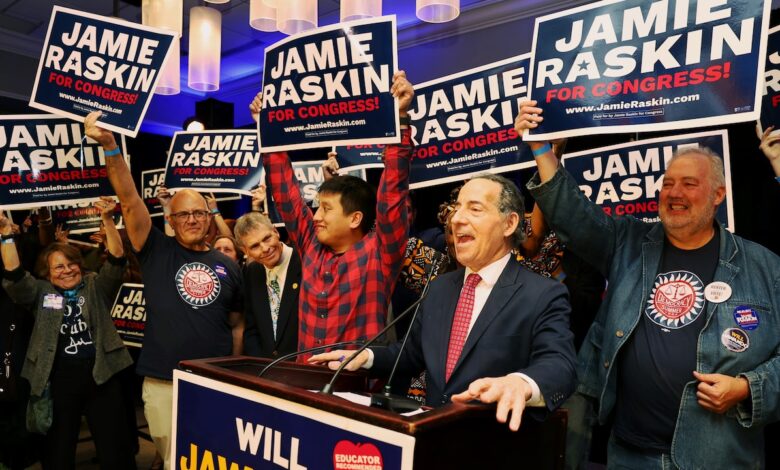
The shift in power grants Democrats substantial leverage over the final two years of the Trump administration. By controlling both the House and the Senate, Democrats can initiate investigations into executive conduct, block legislative initiatives, and utilize the impeachment process as a political tool. The most prominent figure in this new dynamic is Representative Jamie Raskin of Maryland, who is poised to become the chair of the House Judiciary Committee. Raskin, a constitutional law professor and the lead House manager during Trump’s second impeachment trial in 2021, stated in an Election Day interview that Democrats are “not afraid to impeach Donald Trump,” noting that the president accounts for two of the four presidential impeachments in American history, alongside Andrew Johnson and Bill Clinton.
Raskin, who visited polling places in his Montgomery County-based 8th Congressional District on Tuesday, described the election result as “a critical turning point in the history of our country.” He indicated that if selected as committee chair, he would prioritize closing gun-sale loopholes, scrutinizing antitrust deals, and investigating whether the government is being used as a “weapon against the president’s perceived political enemies.” However, Raskin tempered expectations by noting that any impeachment proceedings would be considered “in the full context of everything else we’ve got to get done,” suggesting that legislative action and oversight would remain central to the new agenda.

The move toward potential impeachment is not uniform across the Democratic caucus. Representative Jason Crow of Colorado, a member of the House Armed Services Committee, emphasized that lawmakers have been preparing for extensive investigations into the Department of Defense regardless of the election outcome. Crow cited specific areas of concern, including the removal of senior military officers, alleged misuse of defense funds, threats to NATO stability, potential troop withdrawals from Europe, and the administration’s handling of the Iran war. “Impeachment is only one tool that Congress has,” Crow told TIME, adding that while he would not hesitate to use impeachment if it were the “right” tool to remove Defense Secretary Pete Hegseth and erect guardrails against a “runaway, reckless administration,” the primary goal is to protect national security interests.
The election results have already triggered significant political and market responses. According to reports from Newsweek, the odds of a Trump impeachment in 2027 increased dramatically on prediction market websites following the Democratic victory. In the Senate, Democrats won seats in Maine, Ohio, Iowa, Kansas, North Carolina, South Carolina, and Texas, while holding onto Minnesota. Two races in Mississippi and Alaska remained too close to call as of Wednesday morning, though Democrats had effectively secured a majority by flipping key swing states. In the House, Democrats achieved a guaranteed majority of 218 seats out of 367 declared, overcoming the previous Republican margin of 218-214.
President Trump has reacted to the impending loss of congressional control by threatening a veto-heavy agenda. “I guess I’ll become Mr. Veto,” Trump said this week, predicting that Democrats would send legislation to his desk only to have it rejected. He argued that after a month or two of vetoes, Democrats would be forced to negotiate. In contrast, White House spokeswoman Lauren Bis dismissed the Democratic victory in an emailed statement, claiming the party’s “only agenda is to continue their decade long witch hunt against President Trump.” Bis asserted that the administration would continue to “secure our borders, restore law and order” and deliver economic wins, framing the election as a choice between a “winning, commonsense agenda” and Democratic “obstruction.”
The institutional implications of the Democratic takeover are profound. With control of the House Judiciary Committee, Raskin and his colleagues will have the power to subpoena records, compel testimony, and draft articles of impeachment. This stands in stark contrast to the previous two years, during which Republicans controlled the House. The new leadership also gains the ability to influence the legislative agenda, potentially stalling executive orders and budget proposals. However, the success of any impeachment effort will depend on the Senate, where Democrats would need to secure a two-thirds majority for conviction, or utilize other procedural mechanisms to check executive power.
As the next formal steps begin in January, the focus will shift from electoral rhetoric to institutional confrontation. The Democratic leadership, including Senate Minority Leader Chuck Schumer and House Minority Leader Hakeem Jeffries, has not yet issued detailed policy plans, but the immediate priority will be establishing committee chairmanships and launching oversight inquiries. The potential for a third impeachment represents a unprecedented level of political polarization and institutional tension, with both sides framing the conflict in existential terms. Whether Congress chooses to pursue impeachment or focus on legislative vetoes and oversight investigations remains an open question, but the power to decide now rests firmly with the Democratic majority.