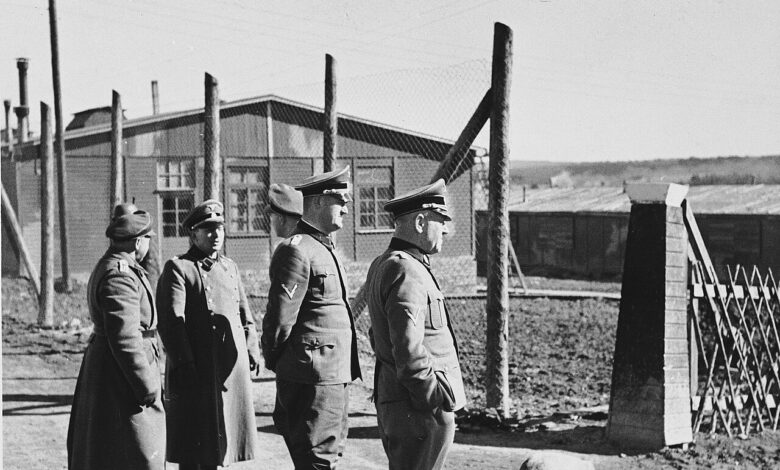
This initial liberation set the stage for a broader Allied operation that would conclude Nazi tyranny in Europe by 1945. According to the Encyclopedia of Camps and Ghettos, there were 23 main concentration camps, known as Stammlager, most of which had a system of satellite camps. Including these satellite locations, the total number of Nazi concentration camps that existed at one point in time is at least a thousand, although these did not all exist simultaneously. The scale of these operations required a multinational military response, with distinct liberation efforts by Soviet, American, and British forces across Europe.
The Soviet forces liberated Auschwitz in January 1945. This site is identified as the largest killing center and concentration camp complex. Simultaneously, American forces moved through central and southern Germany, liberating concentration camps including Buchenwald, Dora-Mittelbau, Flossenbürg, Dachau, and Mauthausen. British forces focused on northern Germany, liberating camps such as Neuengamme and Bergen-Belsen. The conditions confronted by these liberators revealed unspeakable realities that shed light on the full scope of Nazi horrors.

The recognition of these liberating units has been a structured historical process. Since 1985, the United States Holocaust Memorial Museum (USHMM) and the US Army Center of Military History (CMH) have recognized US Army divisions for liberating prisoners from Nazi rule. Initially, this recognition was specific to concentration camps. In May 1995, the USHMM and the CMH agreed to expand the definition to include the liberation of prisons, work camps, forced labor camps, and any facility that held civilians. Through this program, 36 US Army divisions have been formally recognized as liberating units. These divisions include infantry, armored, and airborne units, as detailed in historical tables maintained by the institutions.
Commemoration of these events has evolved over the decades. When the USHMM opened in 1993, twenty divisional flags were displayed in The Samuel and Marcia Mark Hall Honoring American Liberators. For thirty years, these flags were regularly rotated and viewed by millions of museum visitors. However, in 2023, the Museum redesigned the exhibit as part of conservation efforts to preserve the physical artifacts. Today, the USHMM commemorates the US Army divisions recognized as liberating units with a display of 36 flag graphics and insignia rather than the original physical flags. This change allows the institution to honor the service members who risked their lives during World War II while preserving the historical integrity of the original equipment.
The historical record also documents the challenges faced by troops when they encountered the camps. The liberation of these sites was not merely a military objective but a critical moment of historical exposure. The evidence found at sites like Majdanek, where mounds of victims’ shoes were piled outside warehouses, provided tangible proof of the atrocities committed. The collaboration between military historians and memorial institutions ensures that the specific units responsible for these liberations are documented and honored.
As 2025 marks the 80th anniversary of the liberation of prisoners from Nazi concentration camps, the focus remains on the documented facts of these events. The synchronization of military history with humanitarian documentation highlights the magnitude of the Holocaust and the specific actions taken by Allied forces to end it. The distinction between the 23 main camps and the over 1,000 total sites underscores the extensive network of Nazi control that was dismantled between 1944 and 1945. The ongoing preservation of records, from the expanded 1995 definition of liberation to the 2023 exhibit conservation, reflects a sustained commitment to accurate historical remembrance.