

The Third Army Corps announced enemy losses of 2,000 personnel and stated that over 250 Russian soldiers were taken prisoner during this phase. These figures are official claims by the Ukrainian military and have not been independently verified. This development follows earlier actions in the region, including the reported clearing of 75 square kilometers in mid-September and the recapture of Shandryholove and Derylove on September 20. President Volodymyr Zelenskyy noted on September 25 that the operation in the Lymansk area was still ongoing, citing “positive” developments in that direction and others.
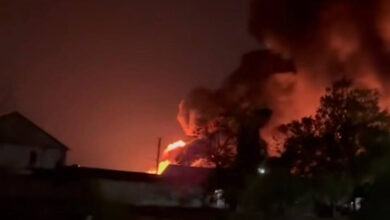
In Dnipro, Ukrainian regional administrator Oleksandr Hanzha reported that a drone struck an office building in the city center, causing a fire and injuries. Emergency services evacuated 47 people from the burning structure, using aerial ladders to reach upper floors. Hanzha confirmed four injured individuals, with search and rescue operations continuing at the scene of the business center. All emergency services were deployed to the location to manage the aftermath of the strike.
Separately, Russian authorities reported damage to railway infrastructure in Bryansk Oblast following drone attacks. Governor Yegor Kovalchuk stated that part of a railway bridge collapsed on the Dyatkovo-Lyudinovo section, causing 10 freight train cars to derail. No casualties were reported in this incident. Kovalchuk also reported that 18 empty semi-trailers derailed in the Unechsky district due to an attack, and noted a further strike on rail lines in the Navlinsky district. These reports highlight the ongoing impact of drone warfare on Russian logistical networks near the border.
Amid these operational developments, European nations continue to coordinate military and financial support for Ukraine. The Netherlands announced it will allocate 10 million euros to establish training centers for the Ukrainian Armed Forces. Additionally, Estonia’s Defense Minister Martin Herem stated that the European Union should utilize frozen Russian assets to support Ukraine. Herem emphasized that this support must continue despite Russian warnings of “punishment,” noting that Estonia will maintain its military aid commitment at 0.25% of its GDP. This stance comes after Russian Foreign Minister Sergey Lavrov threatened European states with consequences should they decide to use the frozen assets for Ukrainian defense purposes.