
Operational Milestones and Platform Capabilities
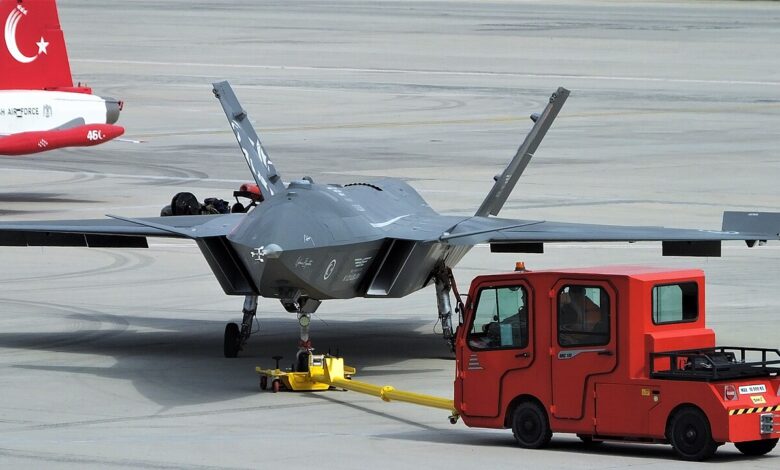
The Kizilelma is a 8.5-ton maximum take-off weight aircraft with a payload capacity of 1,500 kg. It features a low radar cross-section and an Aselsan-developed Active Electronically Scanned Array (AESA) radar. The platform is engineered for short-runway operations and compatibility with aircraft carriers, specifically aligning with the Turkish Navy’s plans to operate unmanned assets from the TCG Anadolu amphibious assault ship.
Prior to the internal weapons bay test, the aircraft demonstrated its air-to-air capabilities in late 2025 by conducting a beyond-visual-range (BVR) engagement over the Black Sea. Using its onboard AESA radar to cue a Gökdoğan missile, the Kizilelma engaged a jet-powered target, a maneuver described by Baykar as the first known air-to-air kill by an unmanned aircraft using its own sensors and indigenous weapons. Technical specifications for the aircraft include a combat radius of 500 nautical miles, a cruise speed of Mach 0.6, a maximum speed of Mach 0.9, and a service ceiling of 45,000 feet.
Indonesia Becomes First Export Customer
On May 6, 2026, Baykar signed its first export agreement for the Kizilelma with PT Republik Aero Dirgantara (Republikorp), an Indonesian defense holding company. The contract covers the supply of 12 unmanned combat aircraft, with deliveries scheduled to begin in 2028. The framework agreement includes options for four additional squadrons, potentially bringing the total order to 48 aircraft.
The deal extends beyond simple procurement, encompassing the establishment of local production and maintenance facilities in Indonesia, technology transfer, and the certification of Indonesian technical personnel. Republikorp Chairman Norman Joesoef characterized the agreement as a continuation of a broader industrial partnership that includes joint ventures for the local production of the Bayraktar TB3 and Bayraktar Akinci drones. Indonesia has also separately ordered the combat-proven Bayraktar TB2 and acquired the Italian carrier Giuseppe Garibaldi, consistent with its interest in carrier-capable unmanned systems.
Strategic Vision and Industry Growth
Baykar CEO Haluk Bayraktar stated that the company aims to begin serial deliveries of the Kizilelma within 2026, following the completion of serial production in 2025. He noted that serial production was finalized last year, with induction into the Turkish Air Force targeted for the current year. Bayraktar described the development as reflective of the transformation in Türkiye’s defense industry over the past two decades, citing a growth from approximately 20 defense companies in 2002 to more than 3,000 firms serving the sector in 2026.
During a visit by a NATO Parliamentary Assembly delegation, Baykar Chairman Selcuk Bayraktar articulated a long-term strategic vision for the platform. He argued that unmanned fighter aircraft will likely replace the world’s roughly 15,000 manned fighter jets within 30 years, describing the shift as a major revolution in combat aviation. Bayraktar emphasized the economic advantages of unmanned systems, noting that the elimination of pilot training removes a significant cost and capacity drain. He stated that unlike manned fleets, where a large portion of the airframe is dedicated to training, unmanned platforms rely on software updates that can be copied instantly, allowing for rapid optimization and deployment.
The Kizilelma is positioned not within the traditional generational framework of manned fighters, but as a distinct category of robotic combat platform. This differentiation is central to Baykar’s marketing of the aircraft as one of the world’s first unmanned fighter jets, a status reinforced by the recent internal weapons bay test and the new export contract with Indonesia.