
On Thursday, the Helsinki District Court found a Russian ship captain and an Azerbaijani crew member guilty of aggravated sabotage. The defendants were involved with the cargo ship Fitburg, which was seized by Finnish authorities on December 31 while sailing from St. Petersburg to Israel. The court determined that the vessel intentionally damaged two underwater telecommunications cables running from Finland to Estonia. According to the verdict, the ship dragged an anchor chain and shank along the seabed for approximately 130 kilometers (81 miles), an act the judges concluded was deliberate rather than accidental.
The legal outcome carries significant weight for the protection of critical infrastructure in the Baltic Sea. The Russian captain was sentenced to three years and six months in prison, while the Azerbaijani crew member received a sentence of two years and ten months. Additionally, the court ordered the two men to jointly pay approximately 1.9 million euros ($2.1 million) in damages, with the captain required to pay an additional 85,000 euros. Both defendants, who have remained in Finland under travel bans since the seizure, deny any wrongdoing and have challenged Finland’s jurisdiction over the case. The captain’s lawyers have announced an appeal, while the crew member has not yet decided whether to contest the verdict. This case follows a series of incidents impacting cables and pipelines in the Baltic Sea, prompting Finland to step up efforts to secure its undersea networks.
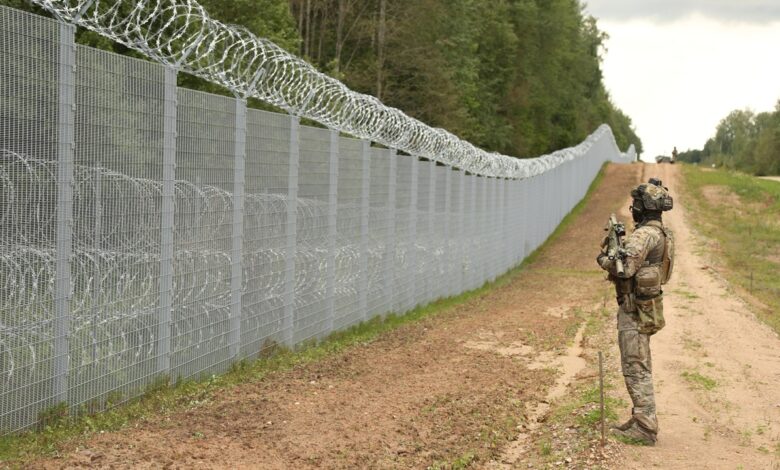
While the Fitburg case has reached a judicial conclusion, a separate incident along the Latvian-Belarusian border has introduced a new layer of uncertainty regarding hybrid warfare tactics. Latvian Public Service Media (LSM) reported that a group identifying itself as “Black Russians” (or “Chyornye Rusy”/”Melnie rusi”) claimed responsibility for an incursion into Latvian territory earlier this month. The group released a video on social media stating that masked, armed men attempted to smuggle at least 20 illegal migrants across the border and damaged infrastructure, including the theft of Latvian border surveillance cameras near the village of Matuliški. The group has vowed further sabotage.
The emergence of the “Black Rus” group has drawn direct comparisons to the “Little Green Men” used by Russia in the 2014 annexation of Crimea, where uniformless personnel seized key infrastructure without clear national insignia. However, the operational context of the Baltic states differs significantly from the 2014 campaign. Jānis Sārts, director of the NATO Strategic Communications Centre of Excellence (SCCE) in Riga, stated that it would be practically impossible for independent armed groups to operate within the tightly controlled border zones of Russia or Belarus without the support and coordination of intelligence services. “It’s some kind of special services project,” Sārts noted, highlighting the difficulty of distinguishing between independent actors and state-sponsored proxies in this environment.
Belarusian President Alexander Lukashenko has denied that Belarus was behind the incursion, going so far as to deny that the event occurred at all. Dmitry Halko, a Belarusian political refugee and military journalist based in Poland, characterized the group as a potential “proxy structure” designed to provide plausible deniability for sabotage activities on the borders. For NATO, the strategic implication is the erosion of clear attribution lines, a core component of deterrence in the region. If armed groups can operate with ambiguity, the threshold for a conventional military response becomes complicated, potentially allowing for sustained pressure on border security without triggering a full-scale conflict.
Simultaneously with these physical and jurisdictional disputes, European retail and food supply chains have come under cyberattack, adding a digital dimension to the hybrid pressure. Over the past three weeks, unknown hackers gained remote access to the cooling systems of nearly 100 stores across at least 11 countries, including Belgium, Sweden, Germany, and the U.K. In some cases, freezer temperatures were manipulated as high as 55 degrees Celsius (131 degrees Fahrenheit), spoiling millions of euros worth of frozen goods. EU officials have described the hacks as a deliberate attempt to disrupt the continent’s food supply network, though they have not formally blamed any specific state or group.
Speculation has centered on Moscow due to online claims by pro-Russian hacker groups, specifically Noname057(16) and Z-Pentest Alliance. Cyber threat researchers told the Financial Times that a Russian-linked group is “very likely” associated with the attacks, citing earlier hacks of freezers at U.S. military bases in August and a 2024 incident at a California meat processing plant accused by the U.S. Justice Department. However, the Kremlin has firmly dismissed these allegations. Spokesman Dmitry Peskov called the claims “absurd,” stating they are “backed up by absolutely no reasoning, no evidence whatsoever.”
The convergence of undersea cable damage, border sabotage, and cyberattacks on critical infrastructure suggests a coordinated campaign to test the resilience and response mechanisms of NATO and EU member states. While the legal conviction in the Fitburg case provides a clear legal precedent for holding individuals accountable for physical sabotage, the attribution of the “Black Rus” incursion and the freezer hacks remains contested. The strategic consequence is a heightened state of alertness in Eastern Europe, where the line between criminal activity, non-state proxy action, and state-sponsored hybrid warfare is increasingly blurred. The next critical developments will likely hinge on the outcome of the Fitburg appeal and whether European intelligence services can provide concrete evidence linking the border group and cyber actors to specific state apparatuses.





One Comment